
Paw Print Crochet Pattern Free: Cute Crochet Paw Coaster Pattern For Pet Lovers
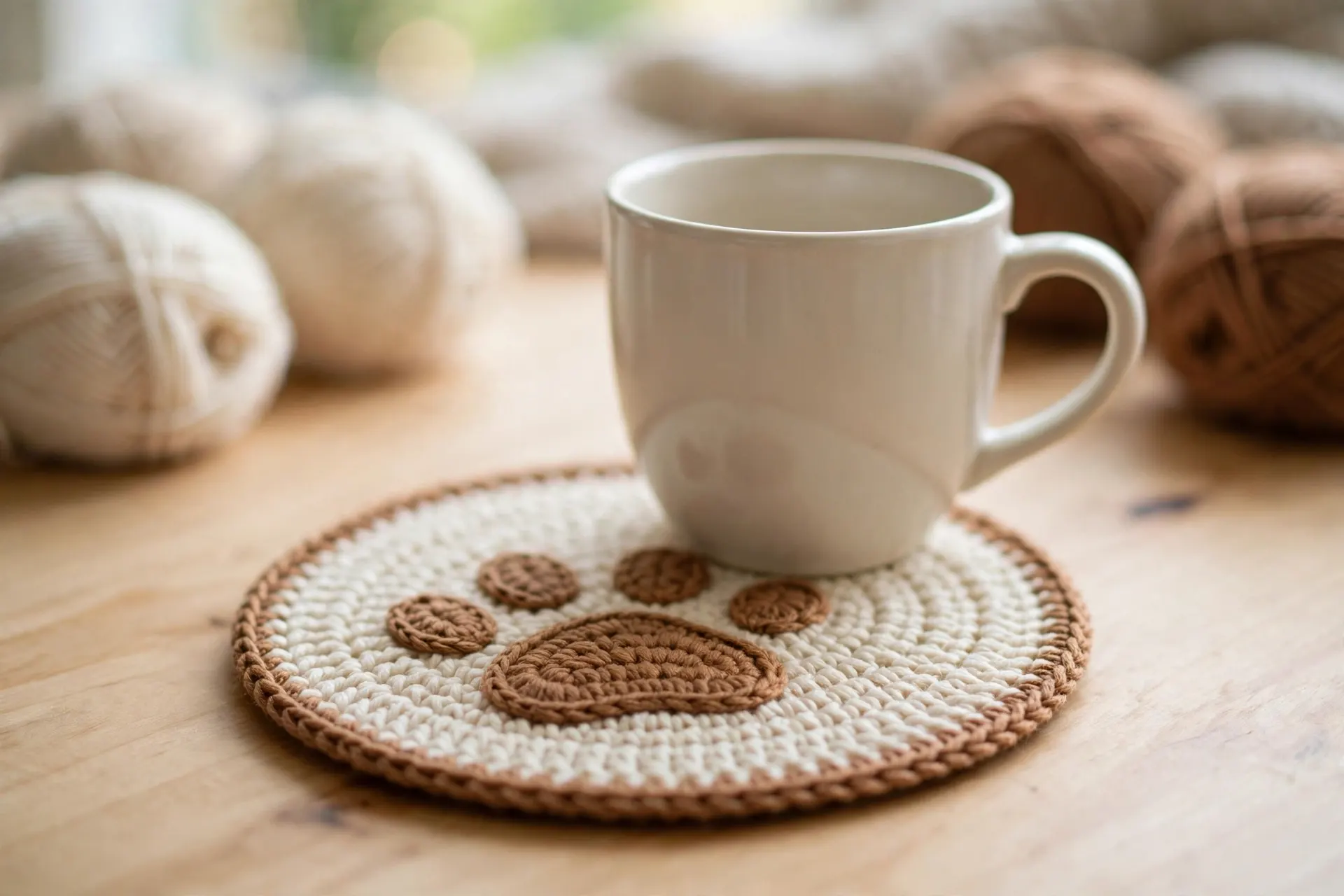
Every pet lover’s coffee table deserves a paw on it. This crochet paw coaster pattern builds the paw print the honest way: a plain, flat cream circle worked in spiral single crochet, then a warm brown pad and four little toe beans crocheted separately and sewn on top, so the print sits proud of the surface the way a real paw print presses into soft ground. Unlike versions that wave vaguely at “adding some taller stitches here and there,” every round below carries an exact stitch count — the base climbs by sixes to 54 stitches, the pad is a counted oval of 16, and each toe bean is a counted oval of 14. One coaster takes well under an hour, and a set of four is the pet-sitter thank-you gift that never misses.
Why You Will Love This Crochet Paw Coaster Pattern
- It is a true one-sitting make. Most crocheters finish one in 35 to 50 minutes, sewing included — a set of four is one relaxed evening.
- It uses one main stitch. Single crochet builds everything; the only extras are an increase and a whipstitch.
- The print cannot drift. Because the paw is sewn onto a blocked-flat base, you place every bean exactly where you want it — no colourwork surprises.
- It eats scraps beautifully. About 35 yards of cream and 12 yards of brown per coaster — the ends of two dishcloth balls are plenty.
- It actually protects the table. Cotton absorbs condensation and gives hot mugs a washable barrier, which acrylic cannot do.
Materials and Tools
What You Need
- Worsted weight (size 4) 100% cotton yarn in cream — approx. 35 yd (32 m) per coaster
- Worsted weight (size 4) 100% cotton yarn in warm brown — approx. 12 yd (11 m) per coaster, for the paw print and edging
- 4.5 mm (US 7) crochet hook
- Tapestry (yarn) needle, for sewing the appliqué and weaving in ends
- Stitch marker
- Scissors
- Pins, for placing the paw before you sew
If yarn weight labels are new to you, the Craft Yarn Council’s standard yarn weight system explains what the “4” on a cotton ball band means. Cotton is non-negotiable for coasters: it absorbs drips, tolerates hot mugs and washes clean — the same kitchen cotton that makes our can cozy crochet pattern hug a cold can will serve you just as well here.
Gauge: 16 sc and 18 rounds = 4 in (10 cm) — about 4 stitches to the inch. The finished size below is built from it, so check your swatch in Step 1.
Finished size: approx. 4¼ in (11 cm) across — the final round’s 54 stitches make a circumference of about 13½ in at gauge, which is a circle about 4¼ in across. The pad measures approx. 1¾ in (4.5 cm) wide and each toe bean approx. 1 in (2.5 cm) long.
Abbreviations (US Terms)
- MR = magic ring
- ch = chain
- sl st = slip stitch
- sc = single crochet
- inc = increase (2 sc worked into the same stitch)
- st(s) = stitch(es)
- rep = repeat
The Crochet Paw Coaster Pattern, Step by Step
Here is the complete crochet paw coaster pattern, worked in two parts: a spiral base first, then the four-piece paw appliqué. Work the base in one continuous spiral — do not join rounds — and move your marker up at the start of every round; the marker line becomes the back of the coaster, giving the paw a clean front to sit on. Every round ends with its count in brackets. If themed coasters are taking over your kitchen, our cat coasters crochet free pattern is this coaster’s natural partner.
Step 1 — Gather Your Materials and Check Your Tension

Lay everything out, including the pins — paw placement is a pinning job before it is a sewing job. Swatch first: work at least 16 sc across and a few rounds, then measure the middle — you want 16 stitches inside 4 in (10 cm). If your stitches run big, drop to a 4.0 mm hook now rather than after the base is done.
Step 2 — Start the Base (Rounds 1–3)

With cream yarn, make a magic ring.
Round 1: Work 6 sc into the ring. Pull the tail to close the ring, but do not join — the spiral continues. (6 sc)
Round 2: Inc in every st around. (12 sc)
Round 3: *Sc in the next st, inc in the next st;* rep from * to * 5 more times. (18 sc)
You should have a small, flat cream coin about 1½ in across. If the centre hole peeks open, tug the ring tail again and it will settle shut.
Step 3 — Grow the Base (Rounds 4–6)

Round 4: *2 sc, inc;* rep around. (24 sc)
Round 5: *3 sc, inc;* rep around. (30 sc)
Round 6: *4 sc, inc;* rep around. (36 sc)
The ladder climbs by exactly six stitches a round — 6, 12, 18, 24, 30, 36 — and the disc should still lie flat. A gentle dome usually flattens under the later rounds; a ripple means an extra increase has crept in, so recount now rather than at 54 stitches.
Step 4 — Finish the Base and Work the Border (Rounds 7–10)

Round 7: *5 sc, inc;* rep around. (42 sc)
Round 8: *6 sc, inc;* rep around. (48 sc)
Round 9: *7 sc, inc;* rep around. (54 sc)
Round 10 (border): Change to warm brown yarn. Sc in every st around, then join with a sl st to the first sc and fasten off. (54 sc)
The brown border round adds no stitches; it frames the cream the way a printed edge frames the paw. Weave in the cream and ring tails now, while the back is bare — the paw will cover the middle, not the edges.
Step 5 — Crochet the Main Pad

With warm brown yarn, ch 5. The pad is a small oval worked around both sides of the foundation chain.
Round 1: Sc in the 2nd ch from the hook, sc in each of the next 2 ch, 3 sc in the last ch. Turning the work to crochet along the underside of the chain, sc in each of the next 2 ch, then 2 sc in the first ch. (10 sc)
Round 2: Inc in the first st, sc in the next 2 sts, inc in each of the next 3 sts, sc in the next 2 sts, inc in each of the last 2 sts. (16 sc)
Round 3: Sc in every st around, then join with a sl st to the first sc. Fasten off, leaving a long tail for sewing. (16 sc)
Check the shape: a smooth oval, widest across the middle, with Round 2’s extra stitches gathered at the two ends — that is what grows a chain into an oval instead of a strip.
Step 6 — Crochet the Four Toe Beans (Make 4)

With warm brown yarn, ch 4. Each toe is the pad’s little sibling — the same oval idea, two chains shorter.
Round 1: Sc in the 2nd ch from the hook, sc in the next ch, 3 sc in the last ch. Turning to the underside of the chain, sc in the next ch, then 2 sc in the first ch. (8 sc)
Round 2: Inc in the first st, sc in the next st, inc in each of the next 3 sts, sc in the next st, inc in each of the last 2 sts. Join with a sl st to the first sc and fasten off, leaving a sewing tail. (14 sc)
Make four toes in total, all before you sew anything. Toes worked in one sitting come out the same size; a toe worked tomorrow, at tomorrow’s tension, will be the one that looks adopted. Each finished toe is about 1 in (2.5 cm) long.
Step 7 — Sew On the Paw, Weave In and Block

Lay the blocked base flat, marker line at the back. Position the pad first: centre it side to side, its middle about ¼ in (0.6 cm) below the coaster’s centre. Then arc the four toes above it — the two middle toes stand upright, tips about ⅜ in (1 cm) in from the edge, and the two outer toes tilt outward at roughly 30 degrees, sitting a touch lower. Leave about ⅜ in (1 cm) of cream showing between the pad’s top and the toes’ bottoms; that gap makes it read as a paw instead of a flower.
Pin everything, step back, and check the arc is symmetrical. Then whipstitch each piece down with its own tail, catching one edge stitch of the appliqué and one stitch of the base with every pass: 16 catches around the pad, 14 around each toe. Sew the pad first, then the toes from the middle outward. Weave in the last ends on the back, then block the coaster flat under a damp cloth for ten minutes. Your paw print coaster is ready for its first mug.
Tips for a Paw That Reads at a Glance
A few simple habits make every crochet paw coaster pattern you work come out cleaner:
- Count the ladder out loud. 6, 12, 18, 24, 30, 36, 42, 48, 54 — if a round ends on any other number, fix it before the next round.
- Pin the whole paw before sewing any of it. Placement is the entire design here; two minutes with pins is the difference between a paw and a bunch of brown ovals. It is the same discipline that makes our egg coaster crochet pattern land its yolk in the middle.
- Sew with the appliqué’s own tail. Matching brown yarn disappears into brown stitches; contrasting thread shows at every catch.
- Keep the gap. Beginners crowd the toes down onto the pad. That ⅜ in of cream is what your eye reads as separate toes — guard it.
- Make the set in one sitting. Four bases first, then four pads, then sixteen toes: matched tension makes the paws come out as siblings.
Common Mistakes and How to Fix Them
- The base curls into a bowl. Your tension is tighter than 16 sc = 4 in, or a ladder round was skipped. Recount; if the count is right and it still cups, go up to a 5.0 mm hook for the base only.
- The edge ruffles like a lettuce leaf. An increase has crept in — each ladder round adds exactly 6 stitches. Recount at the last flat checkpoint and work forward from there.
- The paw looks like a flower. The toes are spaced all around the pad, or they touch it. Toes belong in an arc across the top only, with that ⅜ in gap below them.
- One toe is bigger than the others. It was worked in a different sitting, at a wandering tension. Toes take three minutes each; remake the odd one.
- The appliqué puckers the base. The whipstitches were pulled too tight, gathering the cream underneath. Sew snug, not strangled.
More Crochet Paw Coaster Ideas to Try
The cream-and-brown classic above is the full pattern; these versions of the crochet paw coaster pattern keep the counted base and change the print — just as our swirl crochet coaster turns the same flat disc into something completely different.
Jumbo Paw Mug Rug
- Construction: Keep climbing the ladder past Round 9: Round 10 — *8 sc, inc;* rep around (60 sc). Round 11 — *9 sc, inc;* rep around (66 sc). Work the brown border over 66 stitches. Scale the paw up too: the jumbo pad starts on ch 7 — Round 1 works 14 sc around the chain (sc in the 2nd ch, sc in the next 4 ch, 3 sc in the last ch, sc in the next 4 ch underneath, 2 sc in the first ch), Round 2 grows it to 20 (inc, sc in the next 4, inc in each of the next 3, sc in the next 4, inc in each of the last 2), Round 3 is one even round of 20. Jumbo toes start on ch 5 and follow the hero pad’s counts: 10 stitches in Round 1, 16 in Round 2.
- Size: About 5¼ in (13.5 cm) across — 66 stitches make a 16½ in circumference at gauge. Difficulty: Beginner. Time: About 1 hour.
- Tip: This is the size that fits a soup mug or a small teapot.
Cat Paw Coaster — Smaller, Rounder Print
- Construction: The same 54-stitch base, with a daintier print. Cat pad: ch 4 — Round 1 works 8 sc around the chain, Round 2 grows it to 14 (inc, sc in the next st, inc in each of the next 3, sc in the next st, inc in each of the last 2), Round 3 is one even round of 14. Cat toes are a single round only: the ch 4 oval of 8 stitches — four small round beans instead of ovals. Sit them closer together and barely tilt the outer pair; cat paws are neat, narrow things.
- Size: As the main pattern, about 4¼ in (11 cm) across, with a print about 1¼ in (3 cm) wide. Difficulty: Beginner. Time: About 40 minutes.
- Tip: Pink beans on a grey base is the classic cat-paw colour story, and it is unreasonably cute.
Dog Paw Coaster — Bolder Toes
- Construction: The same base and hero pad (16 stitches, exactly as Step 5), but borrow the jumbo toes: ch 5 ovals worked to 10 stitches in Round 1 and 16 in Round 2. Spread the arc wider and tilt the outer toes further out — dog toes splay where cat toes gather. Everything else, border included, is unchanged.
- Size: As the main pattern, about 4¼ in (11 cm) across, with toes about 1¼ in (3 cm) long. Difficulty: Beginner. Time: About 50 minutes.
- Tip: Work the toes in a slightly darker shade than the pad for a muddy-paw effect that hides real coffee splashes.
Gift Set of Four, Tied and Boxed
- Construction: Work the hero pattern four times: four 54-stitch bases with brown borders, four pads (16 stitches each) and sixteen toe beans (14 stitches each), batching the work — all four bases, then all the appliqué pieces. Stack the finished coasters paw-side up, tie the stack with twine in a cross, and add a card naming the colours after the recipient’s own pet.
- Size: Four coasters, each about 4¼ in (11 cm) across. Difficulty: Beginner. Time: About 3½ hours for the set.
- Tip: You will need about 140 yd (128 m) of cream and 50 yd (46 m) of brown across the set — buy balls, not scraps, so all four match.
Frequently Asked Questions
What is the best yarn for a crochet paw coaster pattern?
Worsted weight 100% cotton, every time. Cotton absorbs condensation, tolerates hot mugs, holds the flat spiral shape and washes clean. Acrylic softens under very hot dishes and lets cold-glass moisture bead straight through to the wood.
How long does one coaster take to make?
About 35 to 50 minutes once the ladder is familiar, including sewing the paw and weaving in ends. Beginners should allow an hour for the first one.
Why does my coaster not lie flat?
Almost always a count or tension problem: a skipped ladder round cups it into a bowl, a stray increase ruffles it. Recheck the ladder (6, 12, 18, 24, 30, 36, 42, 48, 54), relax your grip, and block the finished coaster flat.
Can I make the paw print bigger without making the coaster bigger?
Yes — swap the hero paw for the jumbo paw on the same 54-stitch base: a 20-stitch pad and four 16-stitch toes give a bold, cartoon paw that nearly fills the circle. Keep at least ¼ in of cream margin inside the border so the print does not crowd the edge.
How do I wash crochet paw coasters?
Machine wash with similar colours on a gentle cycle and lay flat to dry, reshaping the paw while damp. Cotton coasters genuinely improve with washing — the stitches settle and the base lies flatter each time.
Final Thoughts
A flat circle, one oval, four little beans — that is all a paw print ever was, and counted out loud it cannot go wrong. Make this crochet paw coaster pattern once for your own table, then make the set for the person whose dog you secretly like more than them. When your coaster drawer needs a sweeter note, the little hearts in our crochet heart patterns collection sew onto cards and garlands just as happily as these paws sew onto coasters.


