Moss Stitch Crochet Pattern: An Easy Linen Stitch Tutorial in 6 Steps
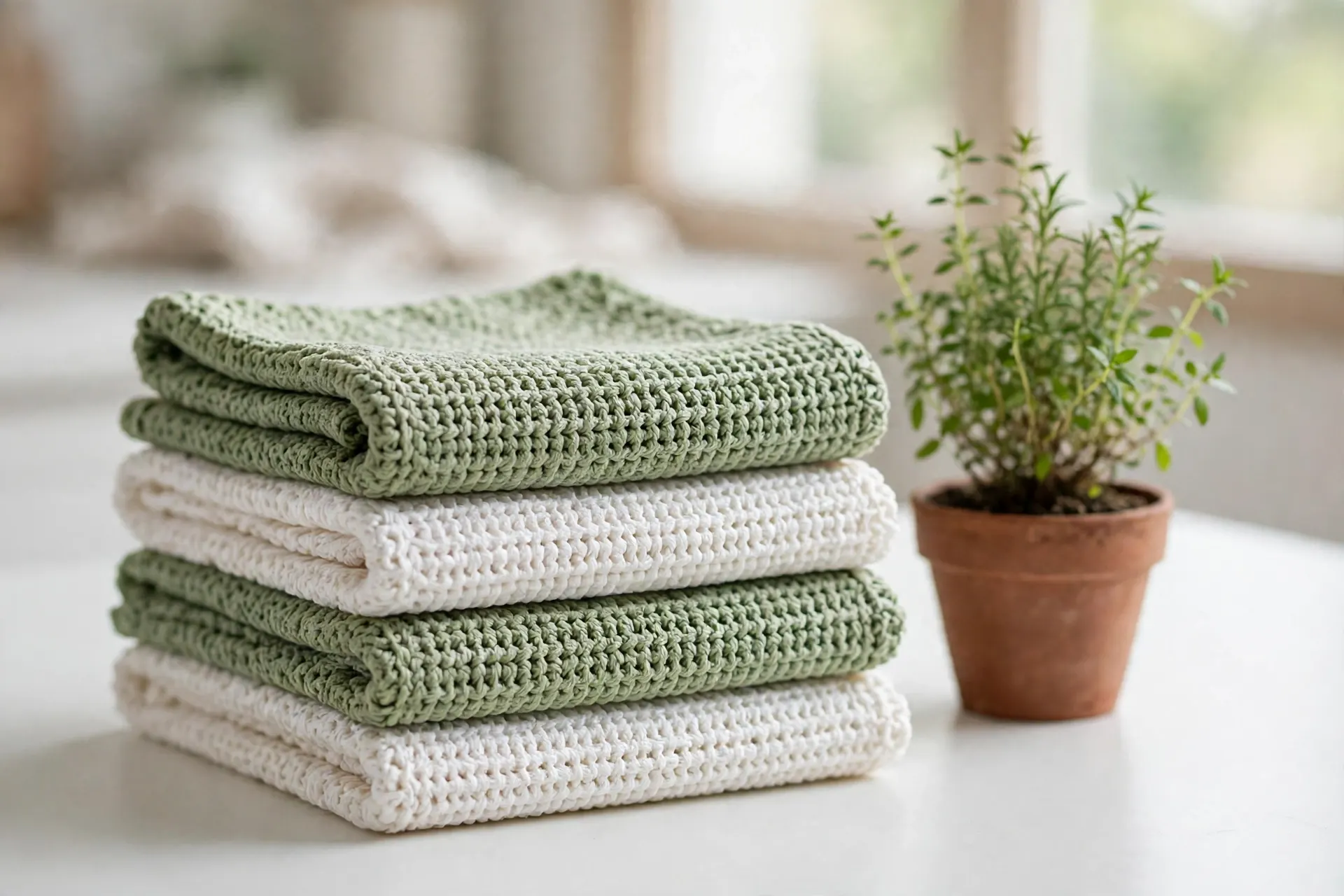
If you only ever learn one textured stitch, make it this one. The moss stitch crochet pattern — also called the linen stitch — uses nothing but single crochet and chains, yet the fabric looks woven and never curls. Here you learn the stitch on a swatch with every count spelled out, then put it to work on a set of cotton dishcloths — exact chain, exact counts, neat border.
What Is the Moss Stitch?
The moss stitch is a simple rhythm of single crochets separated by chain-one spaces. On one row you work a single crochet, chain one and skip a stitch; on the next row your single crochets go into those chain-one spaces instead of into stitches. Each stitch sits in the gap left by the row below, so the fabric gains the tight, even look of woven linen — which is why so many crocheters know this same moss stitch crochet pattern as the linen stitch.
- Only two skills needed. If you can chain and single crochet, you can work moss stitch — there is nothing else in it.
- It lies flat. No curling edges, no blocking battles — the fabric comes off the hook flat.
- It is sturdy and dense. The woven structure wears well — ideal for dishcloths and washcloths.
- It loves stripes. Change colour every two rows and the stitches interlock into a tweedy pattern for free.
- It barely eats yarn. A set of four dishcloths takes roughly 360 yards of worsted cotton — two or three standard balls.
One rule governs everything: the stitch count must be odd, so every row starts and ends with a single crochet.
Materials and Gauge
What You Need
- Worsted weight (#4) cotton yarn, about 90 yd (82 m) per dishcloth, in soft sage green and white here. Cotton is the right fibre for cloths: absorbent, hard-wearing and happy in a hot wash. If yarn labels are new to you, the Craft Yarn Council’s standard yarn weight system explains what the #4 on the band means.
- 5.0 mm (US H-8) crochet hook
- Stitch markers, tapestry (yarn) needle, scissors and a tape measure
Gauge: 18 stitches and 16 rows = 4 inches (10 cm) in moss stitch with worsted cotton and the 5.0 mm hook. Swatch first (Step 1) — gauge decides the finished size — and change hook size if your counts are off.
Finished sizes: swatch about 5½ × 5 in (14 × 12.5 cm); each dishcloth about 8¾ in (22 cm) square before the border, 9¼ in (23.5 cm) with it.
Useful Materials from Amazon
Four basics, and exactly what this moss stitch crochet pattern needs:

- Fiber: 100% Cotton
- Lily Sugar’n Cream yarn is a natural, soft, absorbent cotton yarn that comes in an economical 14 oz cone size.
- Ball Size Solids: 400g / 14 oz, 645 meters / 706 yards
A worsted kitchen cotton is the classic choice — it shows the woven texture crisply, absorbs water well and survives years of washing.

- Easy grip handle
- Amour means love
- Love crochet
A soft-grip 5 mm hook keeps your hands comfortable through a whole set of cloths.

- [150-Piece Value Set in 10 Colors] Get 150 locking stitch markers in 10 colors (15 per shade) to color-code rows, repeat…
- [Smooth Snag-Free Plastic] Lightweight smooth plastic with a gentle locking clasp slides along yarn without catching or …
- [Works for Knitting & Crochet] The slim profile slips onto standard knitting needles, while the secure locking ring mark…
A marker in the first and last stitch of each row guarantees your count stays odd and your edges stay straight.

- Case: Abs Resin, Polypropylene, Needles: Steel
- Imported
- Chibi bent tip needles
A blunt tapestry needle weaves cotton ends in securely — on kitchen cloths, woven ends outlast knotted ones in the wash.
Abbreviations (US Terms)
- ch = chain
- sc = single crochet
- ch-1 sp = the chain-one space from the row below
- st(s) = stitch(es)
- rep = repeat
The Moss Stitch Crochet Pattern, Step by Step
Learn the stitch on the swatch in Steps 1–4, then work the dishcloth in Steps 5–6 — the same rows, just more of them. Every row in this moss stitch crochet pattern ends with its count (single crochets plus chain-one spaces), and that total must stay the same, and odd, on every row.
Step 1 — Materials and Gauge: Make the Swatch

With sage green yarn, chain 26 — this swatch is your practice piece and your measuring piece in one.
- Swatch Row 1: Sc in the 2nd chain from the hook and in every chain across. (25 sc) — an odd count, as moss stitch needs.
- Work the swatch following Steps 2–4 until you have 20 rows in total, then measure the middle: 18 stitches across and 16 rows down should sit inside 4 inches (10 cm). Adjust your hook size if they do not — ten minutes here means every cloth comes out the same size.
Step 2 — Foundation Chain and Row 1
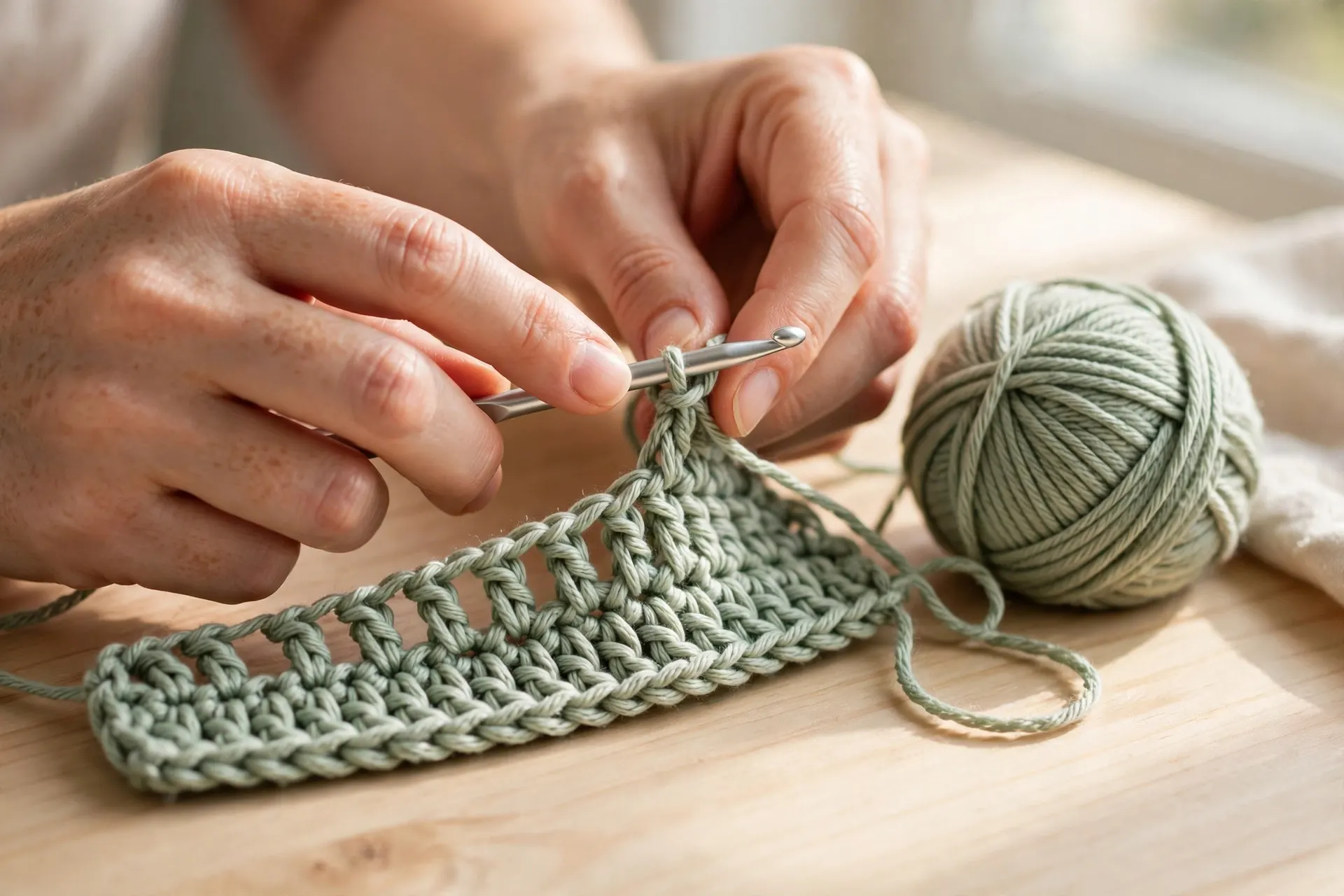
Every piece starts with one plain row of single crochet — the foundation the pattern is built on, and the only row of its kind.
You already made it for the swatch in Step 1: chain 26 gave you 25 sc. For the dishcloth (its numbers are in Step 5) the same row is chain 40, giving 39 sc. An even chain always produces an odd stitch count, because the first chain is skipped — and chain loosely, because a tight foundation chain is the main reason first pieces bow.
Step 3 — Row 2: The Moss Stitch Rhythm Begins

This is the row that creates the chain-one spaces. On the swatch:
- Row 2: Ch 1, turn. Sc in the first stitch, *ch 1, skip the next stitch, sc in the next stitch; rep from * across. (25 sts in total: 13 sc and 12 ch-1 spaces)
Read that count carefully — it is the key to the whole stitch. The row starts and ends with a single crochet, the single crochets land on the odd-numbered stitches (1st, 3rd, 5th … 25th), and each chain one floats over a skipped stitch; those twelve gaps are where the next row’s stitches go. If your count comes out even, pull it back and recount: every later row repeats this one.
Mark the very first and last stitch: they remind you that a single crochet — never a chain space — sits at each edge, which keeps the edges straight.
Step 4 — Rows 3 and On: Working into the Chain Spaces

From Row 3 onwards you stop working into stitches and start working into the chain-one spaces from the row below:
- Row 3: Ch 1, turn. Sc in the first sc, *ch 1, sc in the next ch-1 space; rep from * across, ending with sc in the last sc. (25 sts in total: 13 sc and 12 ch-1 spaces)
- Row 4 onwards: Repeat Row 3 for every row.
Working into a chain-one space pushes the single crochet below it slightly sideways, so your new stitch sits neatly in the gap — that interlocking makes the fabric look woven instead of striped with holes. Your count never changes, and the turning chain never counts as a stitch.
Work the swatch to 20 rows (change to white at the start of Row 11 for the two-colour effect, completing Row 10’s last stitch with the new colour), then measure your gauge as in Step 1.
The dishcloth, in full: chain 40 in sage green. Row 1: sc in the 2nd chain from the hook and in every chain across (39 sc). Row 2: ch 1, turn, sc in the first stitch, *ch 1, skip 1, sc in the next stitch; rep from * across (39 sts: 20 sc and 19 ch-1 spaces). Rows 3–35: repeat the Row 3 pattern — sc in the first sc, *ch 1, sc in the next ch-1 space; rep from * across, sc in the last sc (39 sts on every row). Work 35 rows in total, swapping colours every two rows if you like. Worked to gauge, the cloth measures about 8¾ in (22 cm) square. Do not fasten off — the border comes next.
Step 5 — The Dishcloth Project: The Border Round

A round of plain single crochet frames the cloth and covers the row ends. Continue without fastening off; if your last body row was sage, switch to white for the border, as in the photos.
- Border Round 1: Ch 1. Sc in each stitch and ch-1 space across the top (39 sc), 3 sc in the corner stitch, 1 sc in the end of each row down the side (35 sc), 3 sc in the corner, sc in each stitch across the bottom (39 sc), 3 sc in the corner, 1 sc in the end of each row up the last side (35 sc), 3 sc in the final corner. Join with a sl st to the first sc. (160 sc)
- Border Round 2 (optional): Ch 1, work reverse single crochet (crab stitch) in every stitch around for a firm, corded edge, join and fasten off. (160 sts)
Weave in all ends, running each tail through the backs of stitches in two directions — cotton ends wriggle loose in the wash if only knotted. Repeat for the rest of the set — each cloth takes a relaxed evening. For more kitchen projects, our roundup of crochet dishcloths free patterns is full of quick makes.
Step 6 — Finishing, Washing and Care

Cotton moss stitch needs no blocking: wash, smooth flat, and the cloth is ready. Machine wash warm with like colours; cotton softens with every wash while the woven structure holds its shape.
Smaller washcloth variation: for face and baby cloths, chain 28. Row 1 gives you 27 sc; Row 2 works out to 14 sc and 13 ch-1 spaces (27 sts); repeat to 24 rows in total and border exactly as in Step 5 — 27 sc across the top and bottom, 24 sc down each side and 3 sc in every corner (114 sc in the border round). The finished cloth is about 6½ in (16.5 cm) square with its border — a gentle size for a baby bath, and a fast companion to our open-stitched crochet mesh scarf pattern, which uses open stitches for the opposite effect.
Tips for Even Moss Stitch
- Keep your chains honest. Each chain one should be a real, visible chain — neither a tight thread nor a loose loop. Consistent chains make even spaces, and even spaces are the woven look.
- Count at the end of every row — at first. Thirteen sc and 12 spaces on the swatch; 20 sc and 19 spaces on the cloth.
- Aim into the space, not the stitch. On repeat rows the hook goes under the chain one itself; splitting a stitch means you are in the sc below the space.
- Change colour the clean way. Complete the last single crochet of a two-row stripe with the new colour — pull the final yarn-over through with the new yarn — and the change disappears. More striped inspiration lives in Scrub in Style: 10 crochet dishcloth patterns.
- Keep your edges relaxed. A pulled-tight first or last stitch puckers the sides; keep edge tension the same as the rest of the row.
Common Mistakes and How to Fix Them
Nearly every problem in a moss stitch crochet pattern traces back to the count or to the spaces — both cheap to fix early, annoying late:
- Stripes of holes instead of a woven look. From Row 3 onward you are working into stitches instead of the chain-one spaces. The sc must sit in the spaces — that offset is the whole stitch.
- The count went even and the pattern shifted. A chain was skipped or an extra single crochet crept in, usually at an edge. The row must start and end with a single crochet and total an odd number; unpick to the last good row — moss stitch rips back quickly.
- The sides slope. Stitches are being gained or lost at the ends. Mark the first and last stitch of every row until the habit sticks.
- The middle bows. The foundation chain was too tight. Restart with a looser chain, or chain with one hook size larger and switch back for Row 1.
- The cloth looks holey and loose. Your chains are too generous, or the hook is too big for the yarn. Drop a hook size and keep each chain one snug — the opposite texture problem from our lofty crochet bobble blanket pattern, but the same counted-start cure.
Frequently Asked Questions
Is this moss stitch crochet pattern good for beginners?
Yes — one of the best second projects there is. The whole stitch is single crochet and chains, and the counts let you check your work at the end of every row instead of at the end of the piece. Make the swatch first; by Row 10 your hands will know the rhythm.
What is the difference between moss stitch and linen stitch?
Nothing — two names for the same stitch: “moss stitch” is the common US name, “linen stitch” describes the woven look. (Knitting’s moss stitch is a different texture entirely.) The woven look also makes a beautiful baby blanket — see our honeycomb crochet baby blanket for another gentle texture.
How do I make a moss stitch blanket or scarf?
Keep the two rules: an odd stitch count, and every row a repeat of Row 3. For a blanket, chain any even number to your width — the chain gives you one stitch fewer, keeping the count odd — and work to length, budgeting about 10% more yarn than a plain sc blanket. For a scarf, chain 30 (29 sc) and work until it wraps comfortably.
Which yarn is best for moss stitch?
Cotton for kitchen and bath: absorbent, washable, crisp definition. For blankets and garments, smooth wool or acrylic shows the texture best. Avoid fuzzy or splitty yarns while learning — you need to see the spaces clearly.
Why does my moss stitch look twisted?
Usually the hook enters the chain space from the back, or the work was turned inconsistently. Turn the same way every row and insert the hook under the chain one from the front; a wash straightens minor twist.
Final Thoughts
That is the whole moss stitch crochet pattern: a plain foundation row, one row that makes the spaces, and one row repeated until the piece is done. It asks for nothing but single crochet and a little counting, and in return gives fabric that looks woven on a loom, scalable from a baby washcloth to a blanket. Make the sage and white set, keep one by your sink, and give the rest away.