Bath Pouf Crochet Pattern Free
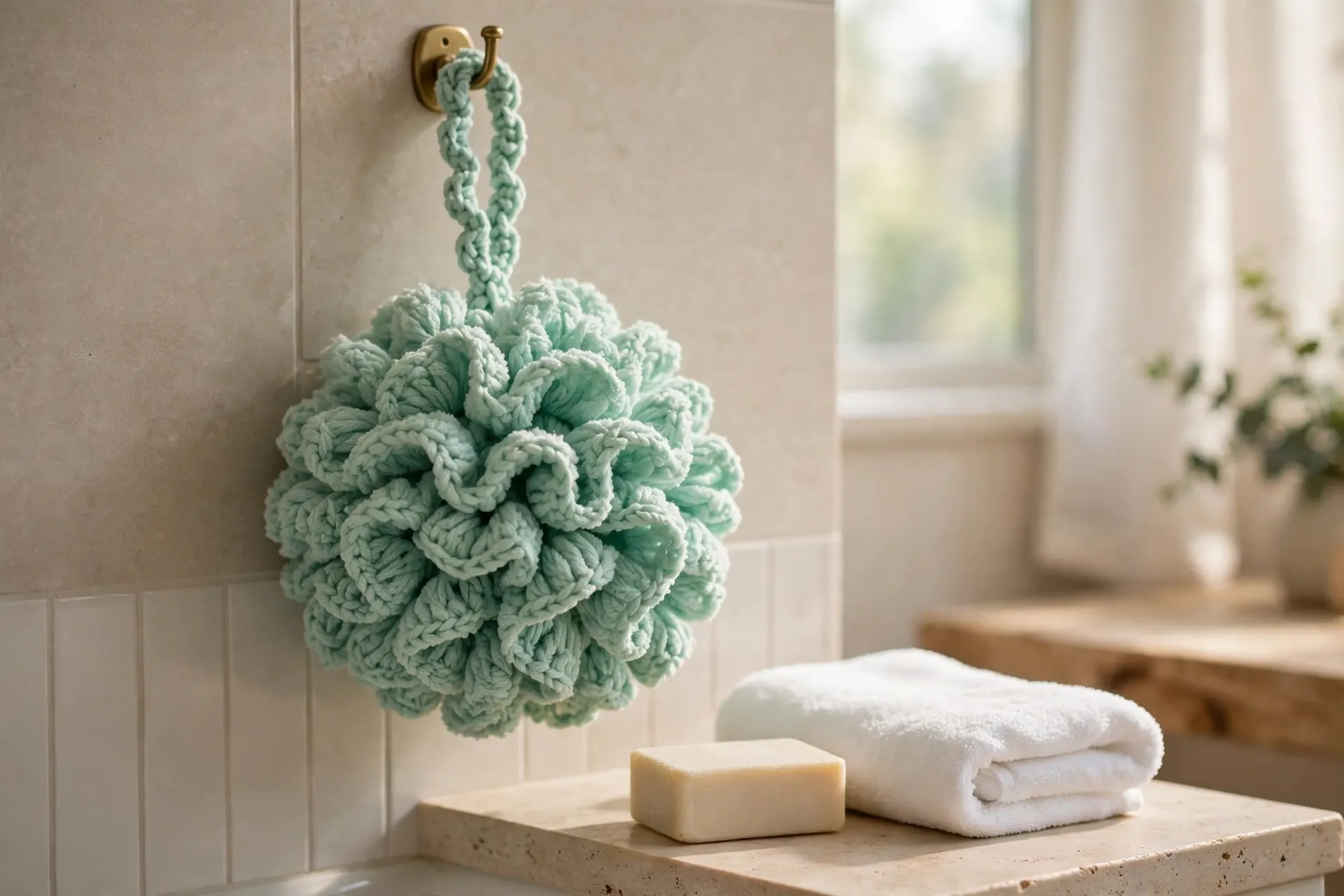
A plastic shower pouf does one job well — lather — and then spends months slowly falling apart in a landfill-bound tangle. This bath pouf crochet pattern gives you the same cloud of ruffles in washable cotton: soft against skin, generous with shower gel, and sturdy enough to go through the wash and come back fluffy. It is a one-evening make from basic stitches, and the whole trick is gloriously simple — you deliberately crochet far too many stitches into far too little space, and the fabric has no choice but to erupt into ruffles. If you can chain, single crochet and double crochet, you can make this pouf tonight.
Why You Will Love This Bath Pouf
- The ruffles are the pattern. Three stitches in every stitch, round after round — no shaping skill needed, the maths does all the work.
- It is washable and reusable. Cotton goes in the machine in a mesh bag and hangs to dry by its own loop, so it replaces disposable plastic poufs for months.
- It is gentle but effective. Smooth cotton ruffles exfoliate lightly without the scratch of plastic mesh.
- It is a brilliant gift. Add a bar of handmade soap and you have a spa gift that looks far more expensive than the ball of yarn it came from.
Materials and Tools
What You Need
- Worsted weight (size 4) smooth cotton or cotton-blend yarn — approx. 150 yd (140 m) for the full-size pouf
- 4.5 mm (US 7) crochet hook
- Tapestry (yarn) needle for weaving in ends
- Scissors
- A mesh laundry bag (for washing the finished pouf, not for making it)
Choose smooth yarn, and choose it on purpose. A bath pouf lives against wet skin, so skip fuzzy, brushed or novelty acrylics entirely: their halo traps soap scum, holds moisture, and feels clammy within a week. A smooth, tightly plied cotton — the same honest kitchen cotton you would pick for our crochet dishcloth patterns — absorbs water, lathers well, dries properly between showers and survives hot washing. A cotton-acrylic blend with a smooth finish is the one acceptable halfway house: it dries a little faster and costs a little less. If yarn weight labels are new to you, the Craft Yarn Council’s standard yarn weight system explains what the “4” on a worsted ball band means.
Gauge: approx. 14 dc and 8 rows = 4 in (10 cm). Gauge is genuinely not critical here — ruffles forgive everything — but a much looser tension makes a bigger, softer pouf that uses more yarn.
Finished size: approx. 5½ in (14 cm) across when fluffed, plus the hanging loop.
Abbreviations (US Terms)
- MR = magic ring
- ch = chain
- sl st = slip stitch
- sc = single crochet
- dc = double crochet
- st(s) = stitch(es)
How the Ruffle Construction Works
Most crochet fights to stay flat. This bath pouf crochet pattern does the opposite on purpose. You start with a small, calm ring of 24 single crochet — then, in every round that follows, you work 3 double crochet into every single stitch. Each round therefore holds exactly three times as many stitches as the round before, crammed onto the same small circle. Fabric that crowded cannot lie flat; it folds, waves and finally erupts into the deep, soft ruffles that hold lather. There is no gathering, sewing or stuffing at the end: the pouf’s shape is simply what happens when 24 stitches become 648 in four rounds. Every round below ends with its exact stitch count in brackets, and the counts multiply cleanly — if your count is not a multiple of the round before, a stitch has been missed or doubled, and it is worth finding before you go on.
The Bath Pouf Crochet Pattern, Step by Step
Step 1 — Make the Hanging Loop and the Base Ring (Round 1)

Everything — loop included — grows from one magic ring, so there is nothing to sew on later.
Loop: Make a MR, ch 40, then sl st into the MR to anchor the chain as a loop. Leave the ring open for now.
Round 1: Ch 1 (does not count as a stitch), work 24 sc into the MR, working over the ring and the starting tail together. Pull the tail to close the ring snugly around the loop’s base, then join with a sl st to the first sc. (24 sc)
Check the loop sits at the top of the ring and the ring is fully closed — this little ring carries the whole pouf’s weight when it hangs dripping, so a firm close now matters more than any other stitch in the pattern.
Step 2 — Work the First Ruffle Round (Round 2)

Round 2: Ch 3 (counts as the first dc), work 2 more dc into the same stitch — that is 3 dc sitting in the first stitch. Work 3 dc into every remaining stitch around. Join with a sl st to the top of the beginning ch-3. (72 dc)
The disc will already refuse to lie flat: it cups, waves and curls at the edges. That is not a mistake — it is the ruffle being born. Smooth it with your fingers, count your 72, and carry on.
Step 3 — Work the Second Ruffle Round (Round 3)

Round 3: Ch 3 (counts as the first dc), work 2 more dc into the same stitch, then 3 dc into every stitch around. Join with a sl st to the top of the beginning ch-3. (216 dc)
By the end of this round the work stops looking like crochet and starts looking like a pouf: deep waves folding over each other, and noticeably more weight in your hands. The stitches are crowded now, so slow down at the joins — the most common error in this pattern is working into the top of the beginning ch-3 by accident, or skipping the stitch right after it.
Step 4 — Work the Final Ruffle Round (Round 4)

Round 4: Ch 3 (counts as the first dc), work 2 more dc into the same stitch, then 3 dc into every stitch around. Join with a sl st to the top of the beginning ch-3. (648 dc)
Yes, 648 stitches — this round is the long, meditative one, and it is meant to be. Put something good on to listen to, keep your tension relaxed so the crowded stitches stay easy to enter, and stop to shake the ruffles out every few minutes. When you join the last stitch, the fabric will be one dense, springy cloud of ruffles with the little base ring hidden at its heart and the loop standing clear at the top.
Step 5 — Finish, Fluff and Hang

Fasten off, leaving a tail of about 6 in (15 cm). Thread it through the base ring’s stitches once more with your tapestry needle and pull gently — a final security cinch for the ring that holds everything — then weave the tail into the base and trim. Weave in the starting tail the same way if any of it remains.
Now fluff: hold the pouf by its loop and shake it hard, then work your fingers into the ruffles, separating and lifting them all the way around until the pouf is round and even. Hang it up by the loop. It is ready for its first shower.
Tips for the Fluffiest Pouf
- Count the base round, trust the multiplication. Round 1 must be exactly 24 — every later count is just 24 multiplied by 3, then 3 again, then 3 again (72, 216, 648). One wrong base stitch compounds quietly.
- Keep tension relaxed in the ruffle rounds. Crowded stitches worked tightly become hard to enter and tire your hands; a loose, easy dc keeps the rounds pleasant and the ruffles soft.
- Mark the first stitch of every round. With hundreds of ruffles, the join disappears. A marker in the first stitch tells you where the round truly ends.
- Work the rounds in one sitting if you can. Ruffle fabric hides tension changes badly — a pouf made across three evenings can show three slightly different ruffle depths. New to working in rounds at all? Our easy circle coaster pattern for beginners teaches the same centre-out start at a calmer pace.
Common Mistakes and How to Fix Them
- The pouf is flat-ish and disappointing. Almost always too few stitches per stitch — 2 dc instead of 3 somewhere, or rounds skipped. The eruption needs the full ×3 every round; there is no gentle version of this maths.
- A hole opens at the centre. The magic ring was not pulled fully closed, or the loop’s anchor slip stitch worked loose. Cinch the ring again with the finishing tail, as in Step 5, and weave the tail through twice.
- The counts drift mid-round. In deep ruffles it is easy to work two groups into one stitch and skip the next entirely. Count in chunks of 24 stitches (one base stitch’s worth of descendants) at intervals rather than attempting all 648 at once.
- The pouf feels heavy and soggy in use. The yarn is the problem, not the pattern: fuzzy or loosely plied yarn drinks water and will not dry. Re-make in smooth, tight cotton and the difference is immediate.
Bath Pouf Variations to Try
Every variation below uses the same loop-and-ruffle method as this bath pouf crochet pattern — only the starting count changes, and because every ruffle round multiplies by 3, the rest of the maths follows by itself.
Mini Facial Pouf
- Construction: Loop of ch 20. Round 1: 12 sc into the MR. Round 2: 3 dc in every st (36 dc). Round 3: 3 dc in every st (108 dc). Fasten off and finish as in Step 5.
- Best yarn: The softest smooth cotton you have — faces deserve the good ball.
- Size: About 3 in (7.5 cm) across. Difficulty: Beginner. Time: About 30 minutes.
- Tip: Make them in pairs and rotate: one in use, one in the wash, since facial poufs need washing most often of all.
Two-Tone Pouf
- Construction: Work Rounds 1–3 in colour A, then change to colour B for Round 4 — the colour change happens in the final sl st join of Round 3, pulling the new colour through for a clean switch. Counts are identical (24, 72, 216, 648); the outer ruffles read as a contrasting cloud around a calm centre.
- Best yarn: Two smooth cottons of the same weight — white with aqua, cream with sage, or grey with blush all look spa-shelf ready.
- Size: About 5½ in (14 cm) across. Difficulty: Beginner. Time: About 1½–2 hours.
- Tip: For a striped spiral instead, change colour at every round join and carry the colour story right through the ruffles.
Kids’ and Travel Size
- Construction: Loop of ch 30. Round 1: 18 sc into the MR. Round 2: 3 dc in every st (54 dc). Round 3: 3 dc in every st (162 dc). Stop there — two ruffle rounds are plenty at this scale — and finish as in Step 5.
- Best yarn: Bright smooth cotton; small hands pick the brightest pouf in the basket every time.
- Size: About 4 in (10 cm) across — a kinder size for small hands and suitcase corners. Difficulty: Beginner. Time: About 45 minutes.
- Tip: One per child, in their own colour, ends the whose-pouf-is-whose argument permanently.
Extra-Full Spa Pouf
- Construction: Loop of ch 40. Round 1: 30 sc into the MR. Rounds 2–4: 3 dc in every st — 90, then 270, then 810 dc. Finish as in Step 5.
- Best yarn: Smooth cotton, and check your yardage first: this one needs approx. 200 yd (185 m).
- Size: About 6½ in (16.5 cm) across — the luxury hotel version. Difficulty: Beginner, but the last round is a marathon. Time: About 2½ hours.
- Tip: Gift it with a scented soap and a handwritten care note; it presents like a boutique set.
Caring for Your Crochet Bath Pouf (Honestly)
A crochet pouf beats plastic on waste, but it still lives in a warm, wet room, and honesty about hygiene is part of the pattern. Follow these habits and yours will stay fresh for months:
- Rinse and hang after every use. Squeeze out soapy water, shake the ruffles open, and hang it by its loop somewhere airy — never leave it in a damp heap on the shower floor, which is where musty smells are born.
- Wash it weekly. Machine wash in a mesh laundry bag with your towels, warm water, ordinary detergent. The bag stops the loop tangling around everything else.
- Dry it completely. Air-dry on the line or tumble dry low; the point is completely. A pouf put away damp is a pouf that smells by Thursday.
- Replace it on a schedule. Even well-kept cotton poufs should retire after about two to three months of daily use — sooner if it smells musty straight after washing, the ruffles fray, or it never quite dries. That is still several times longer than a plastic pouf lasts, and the old one composts or goes in the rag bag rather than the ocean.
- Never share a pouf. One per person, like toothbrushes — the mini and kids’ sizes above make that easy to arrange.
Frequently Asked Questions
Is this bath pouf crochet pattern suitable for beginners?
Yes — it is one of the friendliest first projects there is. The only stitches are chain, single crochet and double crochet, there is no shaping to get wrong, and the ruffles hide uneven tension completely. If you want one practice run at crochet circles first, the round starts in our swirl crochet coaster pattern use the same magic-ring opening.
What is the best yarn for a crochet bath pouf?
A smooth, tightly plied worsted cotton, or a smooth cotton blend. Cotton absorbs water, builds lather, dries between uses and tolerates hot washing. Avoid fuzzy or brushed yarns of any fibre against skin — they trap moisture and soap residue and feel clammy fast.
How long does a bath pouf take to crochet?
About 1½ to 2 hours for the full size, most of it in the final 648-stitch round. The mini facial size takes about 30 minutes and the kids’ size about 45.
Why is my pouf not ruffling enough?
Check two things: that you worked a full 3 dc into every stitch (a stretch of 2 dc quietly flattens a whole sector), and that your base round really was 24 stitches. The fullness is pure multiplication — 24 × 3 × 3 × 3 — so any missing factor shows.
How do I get a good lather from a cotton pouf?
Wetter is better: soak the pouf thoroughly, add shower gel directly to the ruffles, then squeeze and scrunch it in your hand a few times before washing. Cotton builds a slightly softer, creamier lather than plastic mesh — most people prefer it once they have felt the difference.
Final Thoughts
Some patterns impress with difficulty; this bath pouf crochet pattern impresses with arithmetic. Twenty-four calm little stitches, multiplied by three, three times, become a cloud of ruffles that lathers like a dream, washes like a towel and replaces a piece of disposable plastic every few months. Make the first one for your own shower, the second for a gift basket, and keep a mini one by the sink. It sits happily among the other cotton workhorses in this house — our egg coaster crochet pattern for the kitchen table and our sunflower coaster pattern under the mugs — proof that the most useful crochet is usually the simplest.