Bobble Stitch Crochet Pattern
Bobble Stitch Crochet Pattern

If you have ever run your fingers over a cushion covered in soft, squishy bumps and wanted to make them yourself, this bobble stitch crochet pattern is where to start. A bobble is simply five double crochet stitches worked part-way into a single stitch and closed together, so one stitch suddenly holds the fullness of five. Set into flat single crochet fabric, those closed clusters push forward and form the raised dots everyone loves. This tutorial builds a small practice swatch with bobbles in tidy rows, then shifts the second bobble row sideways so the dots sit offset, as they do in blankets and cushion covers. Every row is written out in full, and the count never changes: every row of the swatch holds exactly 31 stitches.
Pattern Essentials
Skill level: Confident beginner — you need chain, single crochet and double crochet.
Gauge: 14 single crochet stitches and 16 rows = 4 inches (10 cm) in single crochet, blocked lightly.
Finished measurements: The practice swatch measures approximately 9 × 5 inches (23 × 13 cm) after light blocking.
Abbreviations (US terms):
- ch = chain
- sc = single crochet
- dc = double crochet
- bo = bobble stitch (defined in full in Step 1)
- st(s) = stitch(es)
- yo = yarn over
- rep = repeat
How the Swatch Is Built
The whole bobble stitch crochet pattern rests on one rhythm: bobble row, plain row, offset bobble row, plain row. The plain rows lock each bobble in place and give you a flat row in which to count. The chain is a multiple of 6 plus 2, so the fabric widens or narrows in steps of 6 chains — just keep the same 2 extra chains at the end.
Step-by-Step: The Bobble Stitch Crochet Pattern Swatch
Step 1: Gather Your Materials and Learn the Anatomy of a Bobble

You will need:
- Worsted weight (weight 4) acrylic or cotton yarn, approximately 100 yards (91 m) — about one 50 g ball — for the swatch
- 5.0 mm (US H-8) crochet hook
- 6 stitch markers
- Yarn needle with a large eye
- Scissors and a tape measure
If yarn labels confuse you, the free Craft Yarn Council yarn weight standards explain what a weight 4 yarn is and which hooks pair with it.

- Content: 100% Acrylic. This yarn is great for knitting, crocheting, amigurumi and craft projects. Easy to care for: mach…
- Ball Size: 454g / 16 oz, 742 meters / 812 yards
- Gauge:#4 Worsted (Medium). Knitting Gauge: 4” x 4” (10 cm x 10 cm) 16 sts x 20 rows with 5 mm knitting needle ,Crochet G…
A soft worsted acrylic is the kindest yarn for a first bobble project: it slides through the five partial double crochets without splitting and springs back so each bobble stays round. Choose a smooth, light colour — you need to see all five legs of every bobble clearly while you learn.

- Easy grip handle
- Amour means love
- Love crochet
Bobbles ask your hook to hold six loops at once, so a comfortable ergonomic 5.0 mm hook with a smooth throat makes a real difference — and a pointed tip helps you find the stitch under a finished bobble on the next row.
Now the anatomy. A bobble (bo) is worked into a single stitch: yarn over, insert your hook into the stitch, yarn over and pull up a loop, yarn over and pull through 2 loops — one double crochet left unfinished, with 2 loops on your hook. Repeat that partial double crochet into the same stitch four more times (6 loops on hook). Yarn over and pull through all 6 loops in one smooth motion, then chain 1 to close the bobble firmly. That closing chain sits on top of the bobble and does not count as a separate stitch — the bobble counts as exactly 1 stitch everywhere in this pattern.
Step 2: Foundation Chain and the First Single Crochet Row

Chain 32 — a multiple of 6 (5 × 6 = 30) plus 2 — which sets the repeat for every bobble row.
Row 1: Single crochet in the 2nd chain from the hook and in each chain across, chain 1, turn. (31 sc)
Count before you go on: exactly 31 stitches. Mark the first and last stitch if edge stitches tend to hide from you — row ends are where counts are most often lost.
Step 3: The First Bobble Row

Row 2 (bobble row A): Single crochet in the first stitch, bobble in the next stitch, single crochet in each of the next 5 stitches; repeat from across, chain 1, turn. (31 sts: 5 bobbles and 26 sc)
Check the maths: 1 starting single crochet plus 5 repeats of 6 stitches (1 bobble + 5 single crochet) = 31, ending with 5 single crochet after the last bobble at stitch 26. Work each bobble as described in Step 1, pushing all five partial double crochets into the same stitch before closing.
After closing each bobble, push it gently toward you with your fingertip from behind the work. Bobbles want to sink back into the fabric; a small push, plus the plain row that follows, sets them proudly on the front.
Step 4: The Plain Single Crochet Row

Row 3: Single crochet in each stitch across, chain 1, turn. (31 sc)
Work one single crochet into the top of every bobble, treating it as the single stitch it is — the closing chain on top looks like a separate stitch, but working into it as well is the most common way this swatch gains stitches. This row flattens the back, pushes the bobbles forward, and gives you a clean count: if you do not have 31 here, the mistake is in the bobble row below, and it is far easier to fix now than three rows later.
Step 5: The Offset Bobble Row

Row 4 (bobble row B): Single crochet in each of the first 4 stitches, bobble in the next stitch, single crochet in each of the next 5 stitches; repeat from 4 times, single crochet in each of the last 3 stitches, chain 1, turn. (31 sts: 4 bobbles and 27 sc)
Count it: 4 + (4 × 6) + 3 = 31. One bobble fewer than Row 2 is correct — starting with 4 single crochet instead of 1 shifts every bobble 3 stitches sideways, into the gap between two bobbles below (stitches 5, 11, 17 and 23 instead of 2, 8, 14, 20 and 26). That half-repeat shift is the secret of the offset layout in this bobble stitch crochet pattern.
To finish the practice swatch, keep the rhythm going:
- Row 5: Single crochet in each stitch across. (31 sc)
- Row 6: Repeat Row 2. (5 bobbles, 31 sts)
- Row 7: Single crochet in each stitch across. (31 sc)
- Row 8: Repeat Row 4. (4 bobbles, 31 sts)
- Row 9: Single crochet in each stitch across. (31 sc)
Fasten off, weave in both ends, and block lightly so the swatch lies flat and the bobbles line up in their offset grid.
Step 6: Keeping Bobbles Evenly Spaced and Counting Between Them

In this bobble stitch crochet pattern the spacing rule is fixed: exactly 5 single crochet stitches between one bobble and the next, and a bobble always replaces a stitch rather than being added on top of one. Clip a marker into the top of each bobble as you close it. Markers should sit at stitches 2, 8, 14, 20 and 26 on an A row, or 5, 11, 17 and 23 on a B row — anywhere else, that repeat went wrong and you can unpick to the last correct marker.
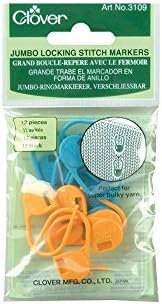
- CLOVER-Jumbo Locking Stitch Markers. Use these handy little tools for marking positions of knitted stitches
- Caution: Keep marker in locked position when not in use
- Material: Polyacetal
Locking markers earn their keep on bobble fabric, because a bobble’s rounded top lets a plain ring marker slide off. Clip one into every bobble and the row counts itself — and leave them in during the plain row to confirm you crochet into every bobble exactly once.
Step 7: Common Mistakes and How to Fix Them

Four problems account for nearly every complaint about the bobble stitch crochet pattern — here is how to spot and fix each one.
The bobble sinks instead of popping. Usually the closing chain was skipped. Reinstate the chain 1 on every bobble, and nudge each bobble to the front with your fingertip as the plain row passes it.
The bobble looks small and flat. Count the legs: a bobble built from only three or four partial double crochets is visibly flatter than its neighbours. The cluster should show five clear strands; if it shows fewer, unpick that one bobble rather than living with a dent.
Your stitch count creeps up. Almost always the closing chain on a bobble top was worked into as an extra stitch on the plain row. Count the plain row out loud — it must end at 31.
Your stitch count creeps down. The culprit is crocheting a single crochet into the same stitch as a bobble, as if it still needed one beside it. A bobble is the stitch — one in, one out, every row.
Step 8: Three Project Ideas for Your New Stitch

A cushion front. Chain 62 (a multiple of 6, plus 2) for 61 stitches, work the A row / plain row / B row rhythm until the panel is a 16 inch (41 cm) square — about 30 rows — then sew it to a plain back panel and insert an 18 inch (46 cm) pad so the bobbles stay plump. My crochet star cushion free pattern shows the panel-and-pad construction, and the cozy tree cushion cover pattern is a festive reuse of the idea.

- PILLOW INSERTS: The package includes 2 decorative 18″x18″ pillow inserts with 100% cotton cover, which is breathable and…
- VERSATILE APPLICATION: Easily fluffy up to display your covers. These are great cushions, and sham stuffers for insertin…
- ADVANCED MATERIALS: 3D polyester fillings provide high resiliency with durability, which feels like traditional down Fil…
A firm 18 inch insert makes a bobble cushion look shop-bought: slightly larger than the cover, it keeps the front smooth and each bobble standing instead of sagging into a hollow. Polyester-filled forms hold square corners best.
A blanket border. Work one plain single crochet row along each blanket edge first, ending with a stitch count that is a multiple of 6 plus 1, then work Bobble Row A along the edge, followed by one final plain row. Two textured rows transform a plain blanket — and my crochet bobble blanket pattern uses bobbles across the whole fabric if you catch the bug.
A hat band. Chain 62 for an adult band (61 stitches), work Rows 1 to 5 from the swatch (one A row and one B row), then seam the short ends together to form a ring about 3 inches (7.5 cm) deep. Slip it over a plain beanie’s brim as a textured cuff, or sew it on. The puff stitch hat crochet pattern uses a cousin of this texture all over, and my crochet headband pattern shows how a simple band is sized and seamed if you would rather wear the band on its own.
Final Thoughts
Once the A row and B row of this bobble stitch crochet pattern feel automatic, you own one of the most useful textures in crochet: polka dots on baby blankets, cosy upholstery on cushions, a smart cuff on hats. Keep the counting habit — one stitch in, one stitch out, 31 stitches every row — and the stitch will never fight you. If you enjoy raised textures, the moss stitch crochet pattern is a gentler next step with the same calm rhythm.