Crochet Mesh Scarf Pattern Free: The Lightweight Crochet Scarf I Keep Wearing Year Round
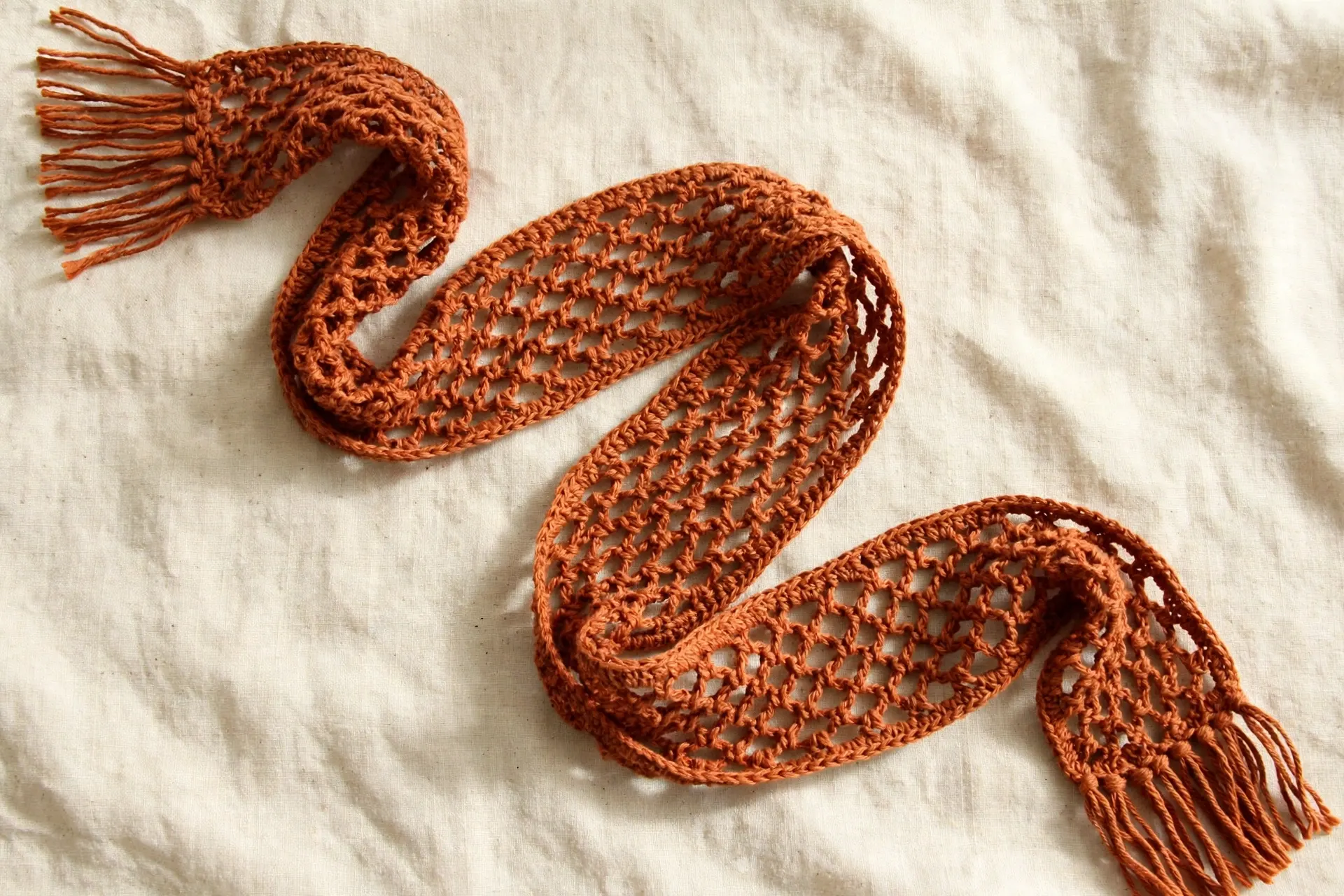
Some crochet projects earn their place in the wardrobe by being useful almost every week of the year, and the mesh scarf is top of that list for me. This crochet mesh scarf pattern makes one complete fishnet scarf with every loop counted: a slim, airy strip of chain-loop mesh, about 5 in (13 cm) wide and 60 in (152 cm) long, finished with a straight single crochet edge and a short fringe. It is the scarf I throw over a plain top on spring days, loop loosely on summer evenings, and layer under a jacket when autumn turns mild — light enough never to feel bulky, warm enough to take the edge off a breeze. The whole design rests on one repeat of four chains and one single crochet, so once the first three rows are in your hands, the remaining rows are pure relaxing rhythm.
Why a Mesh Scarf Works So Hard
Mesh looks delicate, but its secret is efficiency. Most of every row is air: the chain loops do the covering, and the single crochet anchors simply hold them in a grid. That means the scarf grows quickly, uses far less yarn than a solid scarf of the same length, and drapes instead of standing stiffly around your neck. It also breathes, which is exactly what you want from a scarf worn indoors or in changeable weather.
The other reason this design survives in my wardrobe is that it forgives. A solid scarf shows every wobbly edge; a mesh scarf, blocked once and fringed, looks intentional even when your tension wandered a little in the middle rows. If you enjoy scarves and wraps you can wear several ways, it pairs naturally with the styling ideas in our crochet bandana patterns — the bandana is the warm-day head version of the same lightweight thinking.
Before You Start: Yarn, Tension and the One Rule of Mesh
Choose a sport or DK weight yarn (#3) with some drape: a cotton blend gives the crispest mesh and the coolest wear, a soft acrylic blend gives a warmer, fluffier net, and a yarn with a little viscose or bamboo slinks beautifully but stretches — block it gently and expect an extra inch of length. If yarn numbers are still a mystery, the Craft Yarn Council’s standard yarn weight system explains what the #3 on the ball band promises. The scarf below uses about 700 yd (640 m) of DK — roughly three standard 100 g balls — in a warm terracotta, and the fringe is cut from the same yarn.
Tension is the one rule of mesh: keep it relaxed. Tight chains strangle the loops, the scarf narrows, and the drape disappears. A crochet mesh scarf pattern lives or dies on that looseness, because the chains are most of the fabric. Let each chain loop leave the hook at its natural size, and if your single crochet anchors pull the loops sideways, go up half a hook size rather than forcing your hands to work loosely. Count your loops at the end of every row for the first ten rows; after that your hands will know the rhythm, but a ten-second count every twenty rows is still cheaper than frogging forty.
The Complete Crochet Mesh Scarf Pattern, Written in Full
Here is the hero design of this crochet mesh scarf pattern, written out row by row. Read the arithmetic in Step 2 before you pick up the hook: the foundation chain is not a guess, it is a formula — 2 chains of set-up, plus 4 chains for every loop you want across the row. Five loops make the slim scarf below; the variations after the pattern use the same formula with different loop counts, and every one of them has been checked the same way.
Materials
- Sport or DK weight yarn (#3), approx. 700 yd (640 m) — the sample uses three 100 g balls of a cotton-acrylic DK in terracotta
- 4 mm crochet hook
- Yarn needle and scissors
- Tape measure
- Optional: a 12 in (30 cm) piece of card for cutting even fringe strands
Gauge and Finished Size
Gauge: in mesh pattern, 5 chain-4 loops = 5 in (13 cm) across (one loop measures about 1 in wide once blocked), and 14 mesh rows = 6 in (15 cm) of length.
Finished size: about 5 in (13 cm) wide × 60 in (152 cm) long, not counting the fringe, which adds about 6 in (15 cm) at each end. The size is not accidental: 5 loops × 1 in = 5 in of width, and 140 mesh rows ÷ 14 rows per 6 in = 60 in of length.
Abbreviations (US Terms)
- ch = chain
- sc = single crochet
- sp = chain space (the opening under a chain-4 loop)
- st(s) = stitch(es)
- rep = repeat
Step 1 — Gather Your Materials and Check Your Gauge

Work a quick swatch before the real chain: chain 22 exactly as Step 2 describes, work the first row and then four mesh rows, and lay it flat without stretching. You should count 5 loops across, measuring about 5 in (13 cm), and the five rows should measure a little over 2 in (5 cm) — five rows at 14 rows per 6 in is 2.1 in, so anything between 2 and 2¼ in is fine. If your swatch is narrower than 4¾ in, your chains are tight: move up to a 4.5 mm hook. If it spills past 5¼ in, drop to a 3.5 mm hook. Ten minutes here is what makes the finished scarf land on 5 × 60 in instead of somewhere near it.
Step 2 — Chain 22 and Work the First Loop Row

This is the row the whole scarf stands on, so here is the arithmetic in the open. Each loop of the mesh spans 4 foundation chains: 3 chains are skipped underneath the loop, and the 4th chain holds the single crochet anchor. Before the first loop you need 2 set-up chains — 1 chain is skipped as the turning allowance, and the next chain holds the very first anchor. So the foundation is 2 + (4 × 5 loops) = ch 22, and here is the row, walked chain by chain from the hook:
- Row 1: Ch 22. Sc in the 2nd ch from the hook (the chain nearest the hook is the skipped turning chain). *Ch 4, skip the next 3 ch, sc in the next ch; rep from * 4 more times.
Walk it through: the first sc sits in chain 2 counting from the hook. Each repeat then consumes exactly 4 foundation chains — 3 skipped, 1 holding the sc — and builds one chain-4 loop. Five repeats consume the remaining 20 chains precisely (5 × 4 = 20), so the fifth repeat’s sc lands in the very last chain of the foundation, with nothing left over and nothing short. At the end of Row 1 you have 6 sc anchors and 5 chain-4 loops. If you count 5 anchors, a repeat went missing; if your sc did not land in the last chain, a skip was 2 or 4 somewhere — this row is worth redoing, because every row after it simply copies its loop count.
Step 3 — Work the Mesh Row (The One Repeat)

Every row from here to the top is this same row, and it is stable by construction: it uses all 5 loops of the row below and hands back exactly 5 loops and 5 anchors.
- Mesh row: Ch 4, turn. Sc in the first ch-4 sp. *Ch 4, sc in the next ch-4 sp; rep from * 3 more times.
Count the tokens: the opening ch 4 is the edge loop, rising from the last anchor of the row below to the first space — it is a real loop of this row, not just a turning chain. The first sc sits in the first space; the starred unit then runs 4 times in total (the written instruction plus its 3 repeats), once into each of the remaining 4 spaces, each unit adding a ch 4 and an sc. That gives 5 sc and 5 ch-4 loops in total (the opening edge loop plus the 4 loops worked between the anchors), and every one of the 5 spaces below has been used exactly once. The scarf cannot narrow or widen on this row, because spaces consumed and spaces produced are the same number. Work one more mesh row and check it the same way: ch 4 to turn, sc into each of the 5 spaces in turn, a ch 4 before every sc after the first — 5 sc, 5 loops again.
Step 4 — Repeat to 140 Rows and Measure, Don’t Guess

Now simply repeat the mesh row until you have 140 mesh rows in total, counting Row 1 as row 1 — that is Row 1 plus 139 mesh rows. At the gauge above, 140 rows ÷ 14 rows per 6 in = 60 in (152 cm) of length. Build in checkpoints so the length never surprises you: after 20 rows you should measure about 8½ in (21.5 cm), after 70 rows about 30 in (76 cm), and after 120 rows about 51½ in (131 cm). At every checkpoint, also count across: still 5 loops, still 5 anchors on the last row. Mesh hides a dropped loop for a long time, and the checkpoint count is how you catch it at row 43 instead of row 130. If your row gauge runs slightly off — say your 140 rows measure 57 in — add or remove rows in blocks of 14, because each block of 14 rows is exactly 6 in at gauge, and stop at the length you actually want to wear. That steady sameness is the pleasure of a crochet mesh scarf pattern: after the checkpoints become habit, the rows ask almost nothing of you.
Step 5 — Square Off the Top With the Finishing Row

A mesh row ends in loops, and loops make a wavy edge. The finishing row converts the last row’s loops and anchors into a straight line of single crochet, and its count is fixed by the row below it:
- Finishing row: Ch 1, turn. *4 sc in the next ch-4 sp, 1 sc in the next sc; rep from * 3 more times. 4 sc in the last ch-4 sp, 1 sc in the edge anchor at the far end.
Count it honestly: the last mesh row, read backwards as you work into it, offers 5 spaces and 5 anchor points — 4 spaces each followed by the sc anchor between that space and the next, and then the final edge space followed by the edge anchor where the row below began. The starred unit (4 sc in a space + 1 sc in the next anchor = 5 sc) runs 4 times for the first 4 spaces, and the closing instruction covers the fifth space and the edge anchor with another 5 sc: 5 spaces × 4 = 20 sc, plus 5 anchor sc, for a total of 25 sc. Fasten off, leaving a 6 in tail. The bottom of the scarf needs no matching row: the foundation chain is already a straight edge, which is why the fringe in the next step hangs evenly at both ends.
Step 6 — Add the Fringe: One Bundle in Every Space

Fringe is where the mesh count pays you back, because the spaces tell you exactly where the bundles go — no measuring, no spacing guesses.
- Cut 30 strands of yarn, each 12 in (30 cm) long — wrap the yarn around the 12 in card 30 times and cut along one edge.
- Top end: the finishing row sits above the last mesh row’s 5 spaces. Working from the wrong side, fold 3 strands in half, pull the folded loop through one space of that last mesh row, draw the strand ends through the loop and pull snug. Repeat in each of the remaining 4 spaces: 5 bundles, 15 strands.
- Bottom end: repeat through the 5 spaces of Row 1: another 5 bundles, 15 strands. Total for the scarf: 10 bundles and all 30 strands used, each bundle finishing about 6 in (15 cm) long.
Trim the ends level with scissors once both ends are done, cutting against the card or a ruler so the fringe reads as one straight line.
Step 7 — Block It, Weave the Ends, Wear It Everywhere

Weave the two tails (the foundation tail and the fastening-off tail) along the nearest anchor stitches with the yarn needle, travelling in two directions so they cannot work loose. Then block: soak the scarf in cool water for fifteen minutes, roll it in a towel, and pin it flat at 5 × 60 in, opening each loop with your fingers so the mesh dries as a grid rather than a tangle. Blocking is the difference between a scarf that looks homemade and one that looks handmade — the loops relax into even diamonds and the edges stop curling. Wear it looped once with the fringe hanging, doubled with the ends pulled through the fold, or loose as a long accent over a dress; as a gift it travels well, because mesh folds to almost nothing — the same reason the little makes in our crochet heart patterns are such good travellers.
Changing the Size: One Formula, Every Width
Every version of this crochet mesh scarf pattern obeys the same formula, so you never have to guess a starting chain again. For L loops across, the foundation chain is 2 + (4 × L). Row 1 then always ends with L + 1 anchors and L loops, every mesh row always has L anchors and L loops, the finishing row always totals 5 × L single crochet (4 in each space plus 1 on each anchor point), and the fringe always takes L bundles per end. Change L and the width changes at exactly 1 in per loop; change the row count in blocks of 14 and the length changes at exactly 6 in per block. Two ready-worked sizes, plus a different mesh altogether, are below — each one checked with the same chain-by-chain walk as the main pattern. For another project built on a repeat you can resize by formula rather than by guesswork, see our crochet star cushion free pattern, whose points are set by a centre circle divided five ways.
Wider Wrap — 9 Loops
- Foundation: 2 + (4 × 9) = ch 38.
- Row 1: sc in the 2nd ch from the hook, then 9 repeats of (ch 4, skip 3 ch, sc in the next ch) consume the remaining 36 chains exactly (9 × 4 = 36): 10 anchors, 9 loops.
- Mesh rows: ch 4, turn, sc in the first space, then work (ch 4, sc in the next space) 8 times in total, once into each of the remaining 8 spaces: 9 sc, 9 loops every row, stable.
- Size and rows: 9 loops × 1 in = about 9 in (23 cm) wide; work 140 mesh rows for the same 60 in (152 cm) length.
- Finishing row: 9 spaces × 4 sc + 9 anchor sc = 45 sc.
- Fringe: 9 bundles per end, 18 bundles in total, 54 strands of 12 in.
- Yarn: approx. 1,250 yd (1,145 m) of DK — the width is 9/5 of the main scarf, and the yardage scales with it.
Skinny Neck Scarf — 3 Loops
- Foundation: 2 + (4 × 3) = ch 14.
- Row 1: sc in the 2nd ch from the hook, then 3 repeats of (ch 4, skip 3 ch, sc in the next ch) consume the remaining 12 chains exactly (3 × 4 = 12): 4 anchors, 3 loops.
- Mesh rows: ch 4, turn, sc in the first space, then work the unit 2 times in total, once into each of the remaining 2 spaces: 3 sc, 3 loops every row.
- Size and rows: 3 loops × 1 in = about 3 in (7.5 cm) wide; work 98 mesh rows for a neck-scarf length — 98 rows is 7 blocks of 14, and 7 × 6 in = about 42 in (107 cm).
- Finishing row: 3 × 4 + 3 = 15 sc.
- Fringe: 3 bundles per end, 6 bundles in total, 18 strands — or skip the fringe and let the straight edges keep it sleek.
- Yarn: approx. 300 yd (275 m) of DK.
A Different Mesh — Filet-Style Double Crochet Grid
If you prefer a squarer, more graphic net, swap the loops for a double crochet grid. The counts are different, so here they are in full rather than as a vague suggestion. For 16 spaces across:
- Foundation: ch 36 — that is 4 chains of set-up (3 skipped chains of turning height plus the chain holding the first double crochet) plus 2 chains for every space: 4 + (2 × 16) = 36.
- Row 1: Dc in the 4th ch from the hook. *Ch 1, skip the next ch, dc in the next ch; rep from * 15 more times. Walk it: the first dc consumes the set-up 4 chains; each of the 16 units after it consumes 2 foundation chains (1 skipped, 1 holding the dc) and creates 1 space, so 4 + (16 × 2) = 36 exactly and the last dc lands in the final chain. Row 1 ends with 17 dc and 16 ch-1 spaces.
- Row 2 (and every row after): Ch 3 (counts as the first dc), turn. *Ch 1, skip the next ch-1 sp, dc in the next dc; rep from * 15 more times. The unit runs 16 times, each consuming one space and one dc post and producing one space and one post, so every row holds steady at 17 dc and 16 spaces, ending with a dc in the first dc of the row below.
- Gauge and size for this version: 8 spaces = 3½ in (9 cm), so 16 spaces = about 7 in (18 cm) wide; 10 rows = 5 in (13 cm), so 120 rows = about 60 in (152 cm) long.
- Finishing row: ch 1, turn, then 1 sc in every dc and 1 sc in every space across: 17 + 16 = 33 sc.
- Yarn: approx. 800 yd (730 m) of DK — double crochet posts use a little more yarn than chain loops.
Common Mesh Scarf Mistakes (and How to Avoid Them)
- Guessing the foundation chain. A chain of “about 25” cannot produce an even number of 4-chain loops plus the set-up, which is how scarves end up a loop short at one side. Use the formula — 2 + (4 × loops) — and let the last repeat land in the last chain.
- Forgetting that the opening ch 4 is a loop. If you treat the turning chain as height only and work your first sc into the second space, the row loses a loop and the edge steps inward. The ch 4 is space number one of the new row; the first sc goes into the first space below it.
- Counting stitches instead of spaces. In mesh, the space is the unit. Count loops across and anchors across; if both match the row below, the row is right, whatever the chains are doing.
- Pulling the anchors tight. A strangled sc twists its two neighbouring loops out of shape and the diamonds turn into wrinkles. Anchor firmly, not fiercely.
- Skipping the block. Unblocked mesh curls at the edges and hides its own pattern. Fifteen minutes in water and a flat dry at full size is the whole difference — the same lesson the lace sections of our crochet bobble blanket pattern teach on a much bigger scale.
Frequently Asked Questions
How many chains do I start with for a mesh scarf?
For this loop mesh, the chain is 2 plus 4 for every loop you want across: ch 22 for the 5-loop scarf in the main pattern, ch 14 for a 3-loop skinny scarf, ch 38 for a 9-loop wrap. The first anchor goes in the 2nd chain from the hook, each loop then spans 4 chains (3 skipped, 1 anchor), and the last repeat always lands in the final chain — if it does not, a skip somewhere was not 3.
How long should a mesh scarf be?
About 60 in (152 cm) is the versatile length: long enough to loop twice or wear loose with fringe swinging. At this pattern’s gauge of 14 rows per 6 in, that is 140 mesh rows. For a short neck scarf, 42 in (107 cm) — 98 rows — sits neatly at the throat without tails.
What yarn is best for a crochet mesh scarf pattern?
A sport or DK yarn with drape and a smooth surface: cotton blends show the mesh most crisply and wear coolest, acrylic blends are warmer and lighter, and anything very fluffy or heavily textured hides the holes you worked to create. Avoid chunky yarn — the loops turn stiff and the scarf loses the fall that makes mesh worth wearing.
Why does my mesh scarf keep getting narrower?
A loop is being lost at a row end — almost always because the opening ch 4 was not counted as a loop, or the first space of the row below was skipped. Count across at the end of every row (5 loops, 5 anchors for the main size) and the narrowing stops at the row where it starts.
Can a beginner make this scarf?
Yes. The entire scarf uses two stitches — chain and single crochet — arranged in one repeat, which is why a crochet mesh scarf pattern is such a kind first wearable. The only genuinely careful moment is Row 1, where the foundation arithmetic lives; after that, every row is the same five spaces, worked the same way.
Final Thoughts
A mesh scarf succeeds or fails on one small piece of honesty: a foundation chain that is a formula rather than a guess. Get ch 22 right — 2 set-up chains, 5 loops of 4, anchors landing exactly where the arithmetic promises — and this crochet mesh scarf pattern becomes the most relaxing make in your basket: 140 identical rows, a 25-stitch finishing line, fringe counted out by the spaces themselves. Make the terracotta one for yourself, then run the formula again at 3 loops for a gift and at 9 for a wrap, and you will own the same pattern in three completely different moods.



One Comment