
Crochet Christmas Presents: Handmade Gift Ideas for Everyone on Your List
A handmade gift says something a shop-bought one cannot: I thought of you, specifically, and I spent my evenings on it. This collection of crochet christmas presents is built around that idea, and it starts with one complete make — a cosy ribbed scarf written out stitch by stitch, with its stripes and fringe counted too. After it come seven more gifts, each with honest construction notes, real stitch counts, sizes and timings: a mug cozy, a washcloth set, a small basket, a bookmark, a star keychain charm, a plant-pot cover and a pet mat. A quick note before we start: the original version of this post sorted its ideas by recipient and described each one warmly, but it never gave a single stitch count, so you could not actually make anything from it. Every idea it mentioned was a real crochet make — there were no shopping picks hiding in the list — it simply stopped short of patterns. This version keeps the recipient guide, because matching the make to the person is half the gift, and writes all eight makes out properly below.
Before You Start: Yarn, Hooks and What Makes a Good Gift
A good crochet gift comes down to three things: a yarn the recipient can actually wash, a size you checked against the real object or person, and a finish neat enough to survive being used daily. Soft acrylic and wool blends suit scarves and anything worn against skin; sturdy kitchen cotton is the right call for washcloths, baskets, pot covers and pet mats, because it scrubs, holds its shape and goes through the wash without complaint. If yarn weights are new to you, the Craft Yarn Council’s standard yarn weight system explains what the number 4 on a worsted ball band means. Almost everything below is written for worsted (size 4) yarn, so one shopping trip can cover your whole list. Two gauges run through the article — a half double crochet gauge for the scarf and pet mat, and a tighter single crochet gauge for the small makes — and each pattern states its own, so check the one that belongs to the gift in your hands. Finally: weave every end in as if the gift will be washed weekly, because the good ones are.
Crochet Christmas Presents: The Cosy Ribbed Scarf, Written in Full
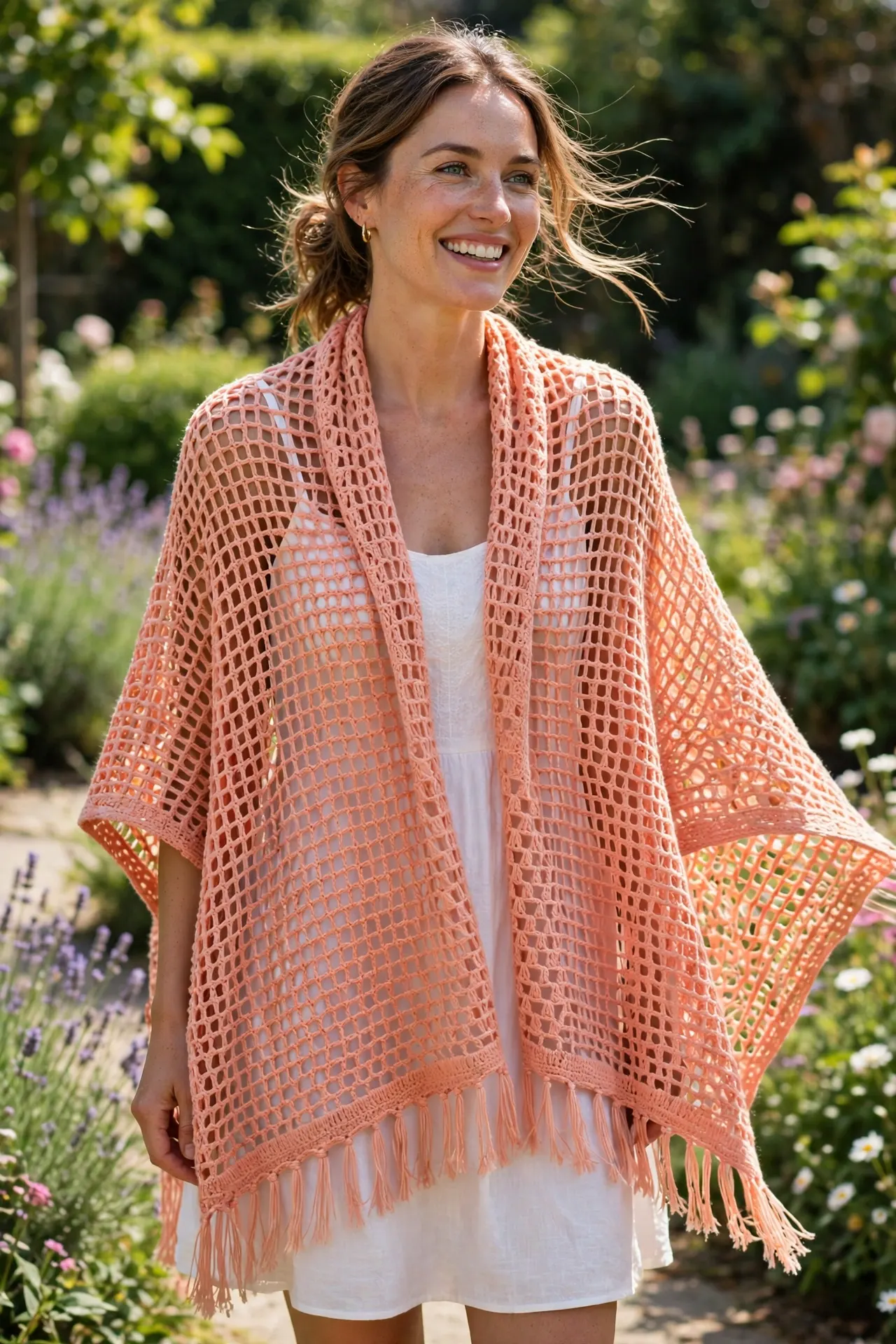
Of all the crochet christmas presents I have made, this ribbed scarf is the one that gets requested again — it is the gift the original post reached for first, for mums and grandmas, and it earns the spot. It is worked flat in half double crochet through the back loop only, which lays every row into a soft rib with real stretch, so the scarf wraps and stays put instead of sliding off a coat. The counts never change from the first row to the last: 28 stitches across, 130 rows long, and the optional stripes fall in thirteen exact bands of ten rows, so a two-colour version needs no measuring and no guessing. Finish it with a counted fringe and it looks like the scarves that cost real money in the shops.
Materials
- Worsted weight (size 4) yarn, approx. 450 yd (410 m) in deep red — or about 300 yd (275 m) of the main colour plus 150 yd (140 m) of cream if you work the stripes and fringe in a contrast
- 5.0 mm crochet hook
- Yarn needle with a large eye
- Scissors and a tape measure
- Optional: a piece of card about 14 in (36 cm) long, for cutting even fringe strands
Gauge and Finished Size
Gauge: 14 hdc and 10 rows = 4 in (10 cm), with every hdc worked in the back loop only — 3½ stitches and 2½ rows to the inch.
Finished size: about 8 in (20 cm) wide and 52 in (132 cm) long, plus roughly 6 in (15 cm) of fringe at each end. The size is just the counts added up: 28 stitches ÷ 3½ stitches per inch = 8 in of width, and 130 rows ÷ 2½ rows per inch = 52 in of length.
Abbreviations (US Terms)
- ch = chain
- hdc = half double crochet
- BLO = back loop only (work the stitch into the back loop of the stitch below)
- sc = single crochet
- sl st = slip stitch
- st(s) = stitch(es)
Step 1 — Gather Your Materials and Check Your Gauge

Lay everything out, then swatch in the rib itself: chain 16, work a row of hdc, then 11 more rows of hdc in BLO, and measure the middle — you want 14 stitches and 10 rows inside 4 in (10 cm). If your swatch runs narrow, your rows are tight: go up to a 5.5 mm hook now, because a scarf that starts an inch narrow stays an inch narrow for 130 rows. Decide on stripes before you chain the scarf: the bands are counted from row 1, and a stripe plan invented at row 60 never lands evenly.
Step 2 — Chain 30 and Work the First Row

Chain 30. Row 1: Hdc in the 3rd ch from the hook and in every ch across. (28 hdc) The 2 skipped chains are simply the turn that lifts you to row height — in this pattern the turning chain is never counted as a stitch, on any row. Count the row: 28. Every row from here to row 130 has exactly 28 stitches, so a row that ends on 27 or 29 is a row to undo now, while it costs twenty seconds.
Step 3 — Work the Rib: Rows 2 to 130

Row 2: Ch 1, turn. Hdc in the BLO of every st across. (28 hdc) Work the last hdc into the last stitch of the row below — not into the turning chain — and the count stays honest.
Rows 3–130: Repeat Row 2. (28 hdc per row — 130 rows in total)
The back-loop ridge is the whole design: each row leaves a raised line, and together they read as knitted ribbing. Build in one checkpoint: at the end of Row 65 you are exactly halfway, and the piece should measure about 26 in (66 cm). If it measures much less, your row gauge is tight — add rows in pairs until you reach the length, because it is the inches, not the row count, that decide whether the scarf wraps twice comfortably.
Step 4 — Add the Stripes (Optional, and Exactly Counted)

For the classic two-colour version, work in bands of 10 rows: rows 1–10 in deep red, rows 11–20 in cream, and keep alternating. Because 130 ÷ 10 = 13, the scarf holds thirteen exact bands and finishes on a full red band, with twelve colour joins along the way. Join each new colour with the last yarn-over of the final hdc of rows 10, 20, 30 and so on up to 120 — pull the new colour through the last two loops of that stitch and the join disappears into the rib. Carry the resting colour loosely up the edge only if the bands were two rows tall; at ten rows, cut and weave instead — a ten-row float shows.
Step 5 — Finish the Last Row and Weave the Ends

After Row 130, fasten off, leaving a 6 in (15 cm) tail. Thread the tail on the yarn needle and weave it along the back of the nearest rib for at least 2 in (5 cm), then back on itself for an inch — a scarf end gets tugged every time it is pulled from a coat hook, and a single-direction weave walks out within a winter. Weave the starting tail the same way. Lay the scarf flat and check the full length once more: about 52 in (132 cm), both ends square, both edges straight.
Step 6 — Add the Fringe: 14 Bundles at Each End

Fringe is where the row counts pay you back, because the stitch count tells you exactly where the bundles go. Cut 112 strands of yarn, each 14 in (36 cm) long — wrap the yarn around your card lengthwise 112 times and cut along one edge. At each short end of the scarf, work one bundle into every other stitch: stitches 1, 3, 5, all the way to 27 — 14 bundles per end. For each bundle, fold 4 strands in half, pull the folded loop through the stitch with your hook, draw the strand ends through the loop and pull snug. That is 14 × 4 × 2 = 112 strands, all used, none left over. Trim the ends level once both ends are done; each bundle finishes about 6 in (15 cm) long.
Step 7 — Block Lightly, Fold and Tag It

Ribbed scarves need only the lightest block: lay the scarf flat at 8 × 52 in (20 × 132 cm), smooth the ribs straight with your palms, and leave it for an hour — no pins, no soaking, because the rib’s spring is what makes it cosy. If you worked the stripes, check both long edges: the bands should line up in straight columns, and a gentle tug along the length evens them if they wander. Fold the scarf in thirds, tie it loosely with a spare strand of the cream yarn, and tuck in a handwritten tag: who it is for, that it was handmade, and how to wash it. Your first gift is ready — and it is the longest make on the list, so everything from here is quicker.
7 More Crochet Christmas Presents to Make
The scarf above is the full pattern; these seven makes from the same original list take the same skills into smaller, faster gifts. Between them they cover everyone the original post worried about — dads, kids, friends, teachers, hosts and the pets — and the matching guide after them says who gets what.
2. Buttoned Mug Cozy
- Construction: Worked flat in single crochet at a gauge of 18 sc and 20 rows = 4 in (4½ stitches to the inch). Chain 45. Row 1: sc in the 2nd ch from the hook and in every ch across (44 sc). Rows 2–15: ch 1, turn, sc in every st across (44 sc per row — 15 rows in total, a band 3 in / 7.5 cm tall). At the very end of Row 15, make the button loop: ch 6, sl st into the same end stitch, fasten off. Sew a ¾ in (2 cm) button at the centre of the opposite end, 1 in (2.5 cm) in from the edge. The flat band measures about 9¾ in (25 cm) and the loop adds roughly 1⅓ in (3.4 cm), so it wraps mugs up to about 10½ in (27 cm) around — the standard 11 oz mug on most kitchen shelves. For a wider travel mug, add 4–5 chains (about an inch) and work the same 15 rows.
- Size: Fits mugs up to about 10½ in (27 cm) circumference; band 3 in (7.5 cm) tall. Difficulty: Beginner. Time: About 1 hour.
- Tip: Measure the actual mug if you can — the cozy that fits the favourite mug is the one that gets used daily. Its taller cousin, our can cozy crochet pattern, uses the same wrap-and-fit thinking for cold cans.
3. Washcloth Set of Three
- Construction: Kitchen cotton at the scarf’s hdc gauge (14 hdc and 10 rows = 4 in). For each cloth: chain 37. Row 1: hdc in the 3rd ch from the hook and in every ch across (35 hdc). Rows 2–25: ch 1, turn, hdc in every st across (35 hdc per row — 25 rows in total). That is 35 stitches ÷ 3½ = 10 in wide and 25 rows ÷ 2½ = 10 in tall: a true square. Edge it in a contrast colour: join the yarn at any corner and work single crochet evenly around all four sides — 35 sc along the top, 35 along the bottom, 25 up each side, with 3 sc in each corner stitch — 128 sc in total, and the corners are where the extra 8 live (each corner stitch takes 3 sc instead of 1). Make three, fold them into a stack and tie with ribbon or a strip of the contrast yarn.
- Size: About 10 × 10 in (25 × 25 cm) each. Difficulty: Beginner. Time: About 1½ hours each.
- Tip: Cotton only — acrylic washcloths repel the water they are meant to mop, and kitchen cotton softens with every wash.
4. Small Stash Basket
- Construction: Single crochet in a continuous spiral at 18 sc and 20 rows = 4 in, in sturdy cotton. Base: Round 1 — 6 sc in a magic ring (6 sts). Round 2 — inc in every st (12 sts). Round 3 — (sc, inc) rep around (18 sts). Round 4 — (2 sc, inc) rep around (24 sts). Round 5 — (3 sc, inc) rep around (30 sts). Round 6 — (4 sc, inc) rep around (36 sts). Round 7 — (5 sc, inc) rep around (42 sts). Round 8 — (6 sc, inc) rep around (48 sts). Round 9 — (7 sc, inc) rep around (54 sts). Every repeat consumes the round before it exactly — the ladder climbs by sixes to 54, a base about 3¾ in (9.5 cm) across. Round 10: sc in the BLO of every st (54 sts) — the back-loop round tips the work upward into walls. Rounds 11–20: sc in every st around (54 sts — 10 rounds, walls about 2¼ in / 5.7 cm tall). Round 21 (handles): sc in the first 8 sts, ch 12, skip the next 11 sts, sc in the next 8 sts, sc in the next 8 sts, ch 12, skip the next 11 sts, sc in the last 8 sts — each half of the round is 8 + 11 + 8 = 27 stitches, so the handles sit exactly opposite each other. Round 22: sc in every sc and 12 sc in each ch-12 space (56 sc), join and fasten off.
- Size: About 3¾ in (9.5 cm) across the base, 2¼ in (5.7 cm) tall, handles rising about 1¼ in (3 cm) more. Difficulty: Easy. Time: About 2 hours.
- Tip: Fill it before you wrap it — chocolates, lip balms, or a rolled pair of the washcloths above — and the basket becomes part of the gift twice over.
5. Simple Bookmark with a Tapered End
- Construction: Single crochet at 18 sc and 20 rows = 4 in. Chain 8. Row 1: sc in the 2nd ch from the hook and in every ch across (7 sc). Rows 2–36: ch 1, turn, sc in every st across (7 sc per row — 36 rows in total, about 7¼ in / 18.5 cm of flat bookmark). Shape the point: Row 37 — dec, sc in the next 3 sts, dec (5 sts). Row 38 — dec, sc in the next st, dec (3 sts). Row 39 — sc3tog: insert the hook into each of the 3 sts in turn, pulling up a loop each time (4 loops on the hook), yarn over and pull through all 4 (1 st). Fasten off. Tassel: cut 6 strands of yarn 8 in (20 cm) long, fold them in half through the centre stitch of the flat Row 1 end with a lark’s head knot, and trim to about 2½ in (6.5 cm).
- Size: About 1½ in (4 cm) wide and 7¼ in (18.5 cm) long, plus the tassel. Difficulty: Beginner. Time: About 30 minutes.
- Tip: Work the whole bookmark in one sitting at one tension — a bookmark worked across two evenings often shows the join as a waist in the middle.
6. Star Keychain Charm
- Construction: Single crochet at 18 sc and 20 rounds = 4 in. Centre: Round 1 — 10 sc in a magic ring (10 sts). Round 2 — (sc, inc) rep around (15 sts). The star’s five points take 3 stitches each, and 15 ÷ 3 = 5 exactly. Work each point in turn: sc in the next 3 sts of Round 2, ch 1, turn; dec over the first 2 sts, sc in the last st (2 sts); ch 1, turn; dec over the 2 sts (1 st); then slip stitch down the side of the point along its 3 row ends to the base, and start the next point in the following stitch. After the fifth point, fasten off. Hanging loop: join the yarn at the tip of the top point, ch 10, sl st into the same tip stitch, fasten off and weave in — then thread a split ring through the loop. Point to point it measures about 2¼ in (5.7 cm). Plush version: make two stars, hold them wrong sides together and whipstitch around the outside matching point for point — about 30 whipstitches, 6 around each point — trapping a pinch of stuffing inside before the last point closes.
- Size: About 2¼ in (5.7 cm) across. Difficulty: Easy. Time: About 45 minutes.
- Tip: Embroider a tiny face with thread if you like, but skip plastic safety eyes on anything for a child — the ring itself is for older children and bag straps. Our crochet keychain pattern ideas collection takes the same tiny-make idea fifteen ways further.
7. Plant-Pot Cover for a 4-Inch Pot
- Construction: The basket’s ladder, grown taller and gently tapered, at 18 sc and 20 rounds = 4 in. Base: work Rounds 1–8 exactly as the basket (6, 12, 18, 24, 30, 36, 42, 48 sts) — a base about 3.4 in (8.6 cm) across, matching the bottom of a standard 4 in nursery pot. Round 9: sc in the BLO of every st (48 sts). Rounds 10–14: sc in every st around (48 sts — 5 rounds). Round 15: (7 sc, inc) rep around (54 sts). Rounds 16–19: sc even (54 sts). Round 20: (8 sc, inc) rep around (60 sts). Rounds 21–24: sc even (60 sts). Round 25: (9 sc, inc) rep around (66 sts). Round 26: sc even (66 sts). Each increase round consumes the previous total exactly — (7 + 1) × 6 = 48, (8 + 1) × 6 = 54, (9 + 1) × 6 = 60 — and the top opens to about 4.7 in (12 cm) across, wide enough to slip over the pot’s rim. Round 27 (optional): a final round of sc in a contrast colour (66 sc) for a clean rim. The 18 wall rounds (Rounds 9–26) stand about 3.6 in (9 cm) tall — just under the rim of the pot, as a cover should sit.
- Size: Fits a standard 4 in (10 cm) nursery pot — about 3¼ in (8.3 cm) across the base, 4½ in (11.5 cm) across the rim, 3¾ in (9.5 cm) tall. Difficulty: Easy. Time: About 2½ hours.
- Tip: Use it decoratively over the plain nursery pot, never as the pot itself — crochet and drainage holes are not friends, and the plant stays in its waterproof inner pot.
8. Cosy Pet Mat
- Construction: Half double crochet at the scarf’s gauge (14 hdc and 10 rows = 4 in), in sturdy washable cotton worked firmly. Chain 47. Row 1: hdc in the 3rd ch from the hook and in every ch across (45 hdc). Rows 2–40: ch 1, turn, hdc in every st across (45 hdc per row — 40 rows in total). The mat measures 45 ÷ 3½ = about 13 in wide and 40 ÷ 2½ = 16 in long. Edge it: join the yarn at a corner and single crochet evenly around — 45 sc along the top, 45 along the bottom, 40 up each side (one in every row end), with 3 sc in each corner stitch — 178 sc in total. Fasten off and weave the ends in twice; a pet mat gets washed often and dragged daily.
- Size: About 13 × 16 in (33 × 41 cm) — right for a cat or a small dog’s bed. Difficulty: Beginner. Time: About 3 hours.
- Tip: No fringe, no loops, no buttons — on pet makes, plain and tight is the safety feature. Wash it once before gifting so it arrives soft and preshrunk.
Who Gets What: Matching Each Make to Your List
The original version of this post organised everything by recipient, and it was right to — the same eight patterns cover the whole list once you match them well.
- For Mum or Grandma: the ribbed scarf in her favourite colour is the classic, and a set of three washcloths folded with a bar of nice soap makes the pamper gift. The small basket suits the bedside table — glasses, lip balm, the remote that wanders.
- For Dad: the scarf again, in a deep, plain colour with the stripes left out, or the mug cozy fitted to the mug he actually uses. The bookmark in a team colour is the stocking extra that takes half an hour.
- For Kids: the bookmark for the young reader, the star charm on an older child’s school bag (embroider the face; keep the split ring for the over-eights), and a basket each for the collections — hair clips, trading cards, small toys. Nothing on this list needs small detachable parts, which is deliberate.
- For Friends: the mug cozy with a packet of their favourite tea tucked inside, the washcloth set as a small spa gesture, or the plant-pot cover for the one whose windowsill is a jungle.
- For Teachers and Hosts: the mug cozy and the bookmark are the thank-yous that stand out in a pile of shop-bought gifts, because nobody else in the class made theirs. Add a handwritten note — it is the part that gets kept.
- For Pets: the mat for the bed, in washable cotton with no loops to catch a claw, and a small basket to keep the toys in one place. Supervise any pet with a new crochet gift at first, and retire it if it starts to unravel.
A Simple Making Schedule (Quick Wins First)
Crochet christmas presents stop being stressful the moment the list has an order. Work quickest first — the early finished gifts build momentum, and the long scarf stops being the thing hanging over December. Rough honest times: the bookmark takes about 30 minutes, the star charm 45 minutes, the mug cozy an hour, each washcloth about 1½ hours, the basket 2 hours, the plant-pot cover 2½ hours, the pet mat 3 hours, and the scarf about 5 hours spread over a few evenings. One of everything is roughly 19 hours of making — two or three gifts a week from early November covers most lists comfortably. If one person on your list deserves a single statement gift instead of a small one, start that one first and earliest: a wearable like our crochet Christmas jumper pattern rewards an early start and punishes a late one.
Wrapping, Tags and the Finishing Touch
Presentation turns a small make into a present. Wrap each gift in tissue paper or a simple gift bag, and add a handmade tag: a small rectangle of card, the recipient’s name and one line of message on the front, and a care note on the back (“machine wash gentle, dry flat” is enough for everything in this article). Punch a hole in the corner, thread it with a strand of the same yarn the gift was made in, and tie it on — the matching yarn tells the story before the tag is read. For an extra ten minutes, top the parcel with a tiny crochet motif instead of a bow: the little heart in our crochet heart patterns collection is one round of crochet, and it goes on the tree as a decoration after the gift is opened.
Gift-Making Tips for Presents That Get Used
Whichever of these crochet christmas presents you make next, these habits separate the gifts that live in daily use from the ones that live in a drawer:
- Fit the gift to a real object. Mug circumferences, pot sizes, scarf lengths — measure the thing the gift must fit, or its near relation, before you chain. Every count in this article came from a measurement.
- Washability is a feature. Gifts for kitchens, bathrooms, children and pets will be washed; choose the yarn that survives it and say so on the tag.
- Make multiples in one sitting. Three washcloths, two bookmarks: tension stays identical, the second is always faster, and you have a spare when someone unexpected joins the list.
- Count the structural rounds out loud. Ladders, handle rounds, split rounds — the rounds where a gift’s shape is decided are the rounds to count twice.
- Weave ends like you mean it. Two directions, at least an inch back on itself. A gift that unravels in January undoes a December of goodwill.
Common Gift-Making Mistakes (and How to Avoid Them)
- Starting with the longest gift. The scarf begun on 20 December is a scarf finished in February. Quick gifts first, long gifts early — the schedule above exists for this exact reason.
- Guessing a mug or a pot size. A cozy two rounds too small fits nothing and gifts badly. Measure, or use the adjustment notes in each pattern.
- Adding buttons and beads to children’s and pets’ gifts. They are the first things chewed, pulled and swallowed. Embroidered details give the same charm with none of the risk.
- Loose tension on working gifts. Baskets, pot covers and pet mats hold their shape only if the fabric is firm — if your stitches look airy, drop half a hook size.
- Skipping the care note. Recipients guess, guess wrong, and felt or stretch a gift that took you hours. One line on the back of the tag prevents all of it.
Frequently Asked Questions
What crochet christmas presents should a beginner start with?
The bookmark, the mug cozy and the washcloths. All three use basic stitches, finish in an evening or less, and forgive uneven tension gracefully. Make one of each, and you have the counting habits the basket and the scarf need.
How far ahead should I start making crochet gifts?
Early November is comfortable for a list of small crochet christmas presents; mid-October if a scarf or anything wearable is on it. The honest unit is evenings, not weeks: at two or three evenings a week, the whole list in this article — about 19 hours of making — takes five or six weeks at a relaxed pace.
How many gifts can I realistically make in one season?
Count stitches, not people: the seven smaller makes here total about 14 hours between them, so a list of eight to ten recipients is entirely reasonable if most of them get a small gift and one or two get the scarf. What sinks a handmade Christmas is never the list length — it is starting late.
Are crochet gifts safe for children and pets?
Yes, with safe versions chosen deliberately: embroidered faces instead of plastic eyes, no buttons or beads where small hands and mouths are involved, tight stitches that claws cannot hook into loops, and ends woven in securely. Supervise pets with any new gift at first, and replace anything that starts to unravel.
Final Thoughts
The secret of a handmade Christmas was never a complicated stitch — it is a short list, honest counts, and a start made before December. Make the scarf from these crochet christmas presents first if your list has a scarf person on it, then let the small makes carry the rest: a cozy here, a bookmark there, a basket filled with something nice. And when a small person in your life needs entertaining while the grown-ups cook, the play food in our pumpkin pie crochet pattern is the same ladder-and-counting magic in the shape of dessert. Eight real patterns, every one of them counted — your list starts with a swatch.