Cotton Candy Crochet Pattern Tutorial Free
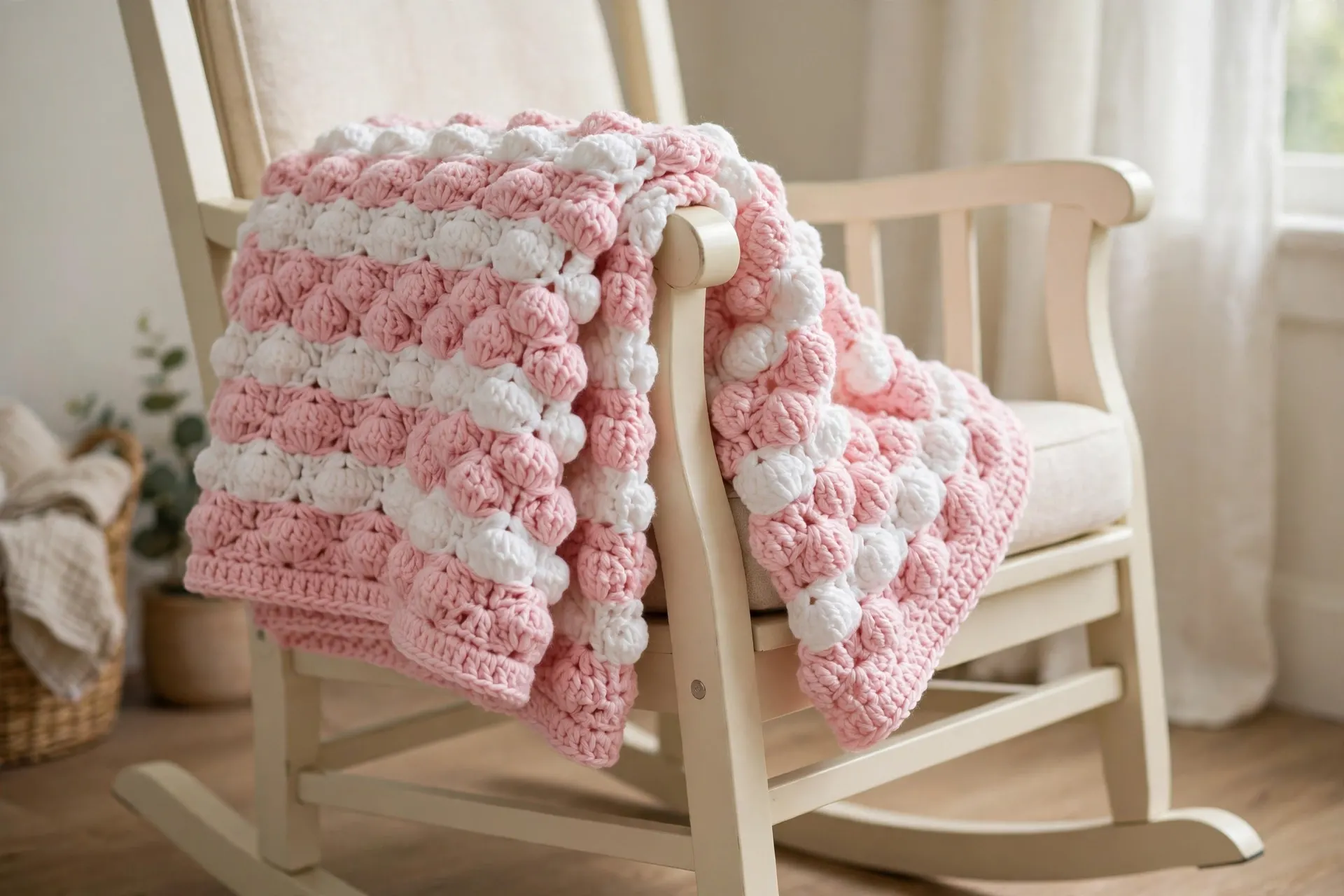
If you love soft, fluffy crochet with a sweet, dreamy look, this cotton candy crochet pattern is a wonderfully satisfying make. The secret is a simple puff stitch in a two-row repeat: puffs rise out of a flat crochet background, like little clouds of spun sugar. In pink and white stripes it is pure fairground nostalgia — and the one extra stitch takes an afternoon to learn.
Below is the complete pattern for a baby blanket — every row counted — plus throw and scarf sizes, colour ideas, and best tips. Every size in this cotton candy crochet pattern uses the same two-row repeat.
Why You’ll Love This Cotton Candy Crochet Pattern
- Beginner-friendly two-row repeat. One row of puffs, one row of single crochet — after a few rows you barely need the pattern.
- Beautiful textured finish. The puffs catch the light, giving the fabric a soft, quilted look plain stitches never achieve.
- Easy to customise in any size. The stitch works over any odd stitch count, so lovey, blanket, throw and scarf all use the same rows.
- Perfect for gifts. In pastel stripes, a thoughtful baby shower or birthday gift that looks far more complicated than it is.
Materials, Gauge and Finished Size
Materials
For the baby blanket:
- Worsted weight (#4) acrylic yarn: approx. 630 yd (575 m) in soft pink (Colour A) and approx. 630 yd (575 m) in white (Colour B) — about 1,260 yd (1,150 m) in total. Puff stitches are yarn-hungry; soft acrylic is light, washable and holds the puff shape well
- 5.5 mm (US I-9) crochet hook
- Yarn needle with a large eye
- Scissors
- Stitch markers (optional, helpful at row ends)
- Measuring tape
Gauge and Sizes
Gauge: 14 sts and 12 rows = 4 in (10 cm) in the stitch pattern below, after light blocking.
Swatch first: chain 22, work Row 1 (21 sc), then the two-row repeat from Step 3 until you have 12 rows. The middle 4 in (10 cm) should show 14 stitches — too many, go up a hook size; too few, go down. New to yarn labels? The Craft Yarn Council’s standard yarn weight system explains what the weight numbers mean.
The stitch works over any odd number of stitches — chain one more than the stitch count you want. Change the size, never the method:
| Size | Chain | Stitches | Rows | Finished size (approx.) | Total yarn (approx.) |
|---|---|---|---|---|---|
| Baby blanket | 114 | 113 | 108 | 32 × 36 in (81 × 91 cm) | 1,260 yd (1,150 m) |
| Throw | 170 | 169 | 180 | 48 × 60 in (122 × 152 cm) | 2,800 yd (2,560 m) |
| Scarf | 30 | 29 | to length | 8 × 60 in (20 × 152 cm) | 700 yd (640 m) |
Abbreviations (US Terms)
- ch = chain
- sc = single crochet
- puff st = puff stitch (explained below)
- st(s) = stitch(es)
- rep = repeat
- sl st = slip stitch
Puff stitch (puff st): (Yarn over, insert hook into the indicated stitch, yarn over and pull up a loop) 3 times in the same stitch — 7 loops on your hook — then yarn over and pull through all 7 loops. Pull each loop to the same height — roughly double-crochet height — so the puffs come out plump and even.
The Complete Cotton Candy Crochet Pattern: Puffy Baby Blanket
Here is the complete cotton candy crochet pattern for the baby blanket, worked flat in rows from the bottom edge up. Colours change in bands of 6 rows — 18 bands, starting with pink and alternating, so band 18 is white and the blanket finishes on a white band. The turning chain-1 does not count as a stitch: work the first single crochet of every row into the first stitch itself. All puffs pop out on the same side — treat that side as the front.
Step 1 — Gather Your Materials and Check Your Gauge

Lay everything out, then work the gauge swatch and adjust your hook if needed. Puff fabric relaxes slightly after blocking, so a fraction small is fine — a full stitch out means changing hooks now, not unravelling later. Taking a moment here means the cotton candy crochet pattern will come out at the size you expect.
Step 2 — Foundation Chain and First Row

With Colour A (pink), chain 114.
Row 1: Sc in the 2nd chain from the hook and in each chain across. (113 sc)
From here on, chain 1 at the start of every row — it does not count as a stitch.
Step 3 — Work the First Puff Row

Row 2 (puff row): Ch 1, sc in the first st, *puff st in the next st, sc in the next st; rep from * across. (113 sts: 56 puff sts and 57 sc)
Row 3: Ch 1, sc in each st across — work into the top of every puff stitch just like any other stitch. (113 sc)
That is the whole stitch pattern: a puff row, then a plain row. Every puff row has exactly 56 puffs and every row exactly 113 stitches, so count at the end of Row 3: a wrong count means the mistake is in the row just finished — far easier to fix now than ten rows later.
Step 4 — Build the Stripes: Repeat the Rows and Change Colours

Keep repeating Rows 2 and 3, changing colour every 6 rows to make the bands:
- Band 1: Rows 1–6 in Colour A (pink)
- Band 2: Rows 7–12 in Colour B (white)
- Band 3: Rows 13–18 in Colour A (pink)
- Continue alternating up to Band 18: Rows 103–108 in Colour B (white)
How to change colour cleanly: on the last stitch of a band’s last row, work the sc until 2 loops remain on your hook, then yarn over with the new colour and pull through both loops. The next row starts in the new colour with no knot and no jog. Do not cut the yarn at each band — carry the unused colour loosely up the side edge; the Step 6 border covers those floats, and you will have far fewer ends to weave in.
If you tend to miss edge stitches, mark the first and last stitch of each puff row for the first few bands.
Step 5 — Finish the Body and Check Your Size

Work your final puff row as Row 107, then finish with Row 108: Ch 1, sc in each st across. (113 sc) Fasten off Colour B, leaving a 6 in (15 cm) tail.
Lay it flat and measure: unblocked, close to 32 in (81 cm) wide and 36 in (91 cm) long. Quick audit: 18 bands, 54 puff rows, exactly 113 stitches in the last row. Slightly under size is fine — border and blocking will finish the job. If the size is close, the cotton candy crochet pattern is ready for its border.
Step 6 — Add the Border

A plain border frames the stripes, hides the carried side floats, and stops the fabric curling.
Round 1: With Colour B (white), join with a sl st in the top right-hand corner stitch. Ch 1, sc in the same st and in each st across the top edge (113 sc), ch 2 (corner), work 108 sc evenly down the side (one per row end), ch 2 (corner), sc in each st across the bottom edge (113 sc), ch 2 (corner), work 108 sc evenly up the other side, ch 2 (corner). Join with a sl st to the first sc. (442 sc and 4 ch-2 corner spaces)
Round 2: Ch 1, sc in each sc around, working 3 sc into each ch-2 corner space. Join with a sl st to the first sc. (454 sc) Fasten off — or first work a corded round of reverse single crochet (crab stitch) in each st around. (454 sts)
Step 7 — Weave In Ends, Block and Care

Weave in the tail and any cut ends, running the needle through the backs of stitches so they cannot work loose — carrying the yarn up the sides means very few ends.
Block lightly: lay the blanket on a clean towel or blocking mats, pat it out to 32 × 36 in (81 × 91 cm), and steam gently from a few inches above the surface, or mist with water and dry flat. Never press a hot iron directly onto acrylic — it melts fibres and flattens puffs forever. Wash gentle in cool water; dry flat or on the lowest tumble setting.
More Ways to Use This Cotton Candy Crochet Pattern
The baby blanket is only the beginning: because this cotton candy crochet pattern is a stitch repeat, not a fixed-size design, it adapts to almost any project. Love textured blankets? My honeycomb crochet baby blanket free pattern is a lovely companion make.
Make It a Throw Blanket
Chain 170 and work the same repeat for 180 rows (169 sts) for a 48 × 60 in (122 × 152 cm) throw in the same 6-row bands — 30 in total. Budget about 2,800 yd (2,560 m); work the border as written (180 sc per side). For a lighter warm-weather drape, try these breathable crochet summer blanket patterns instead.
Make It a Scarf
Chain 30 (29 sts) and work the bands to about 60 in (152 cm) — roughly 180 rows, or stop at the end of any complete band. You will need about 700 yd (640 m). For fringe, cut 12 in (30 cm) lengths, fold in bundles of three, and knot through every other stitch along both short ends.
Colour Ideas Beyond Pink and White
- Classic fairground: soft pink with baby blue — the two colours of the cotton candy stand.
- Lavender dream: lavender with cream, for a softer vintage nursery feel.
- Mint sorbet: pale mint with white — fresh for spring babies.
- Pastel rainbow: rotate pink, cream, mint, baby blue and lavender bands for the full candy-shop effect.
- One colour only: a single soft colour (white, cream, palest pink) lets the texture itself become the pattern. Light colours show puffs best; dark yarn swallows them.
Baby Gifts and Smaller Makes
Shrink the stitch into a lovey: chain 64 (63 sts), work 54 rows (9 bands) for an 18 × 18 in (46 × 46 cm) mini blanket using about 260 yd (240 m) — perfect for a pram or car seat. Building a layette? Browse these 7 crochet baby blanket patterns that are actually worth making for matching ideas.
Tips for the Fluffiest Texture
These tips apply to any size of the cotton candy crochet pattern you decide to make. Keep these in mind and your cotton candy crochet pattern will stay fluffy wash after wash.
- Pull every loop to the same height. Uneven loops are the number one cause of scruffy puffs — aim for double-crochet height, every time.
- Do not strangle the puff. Pull through all 7 loops smoothly, not tightly; a puff closed too hard lies flat and loses its cloud shape.
- Count the puffs, not just the stitches. Each puff row has exactly 56 puffs — counting puffs catches a missed stitch faster than counting 113 stitches.
- Keep the plain rows firm. The contrast between a tidy background row and a plump puff row makes the texture pop; a sloppy background lets the puffs sink in.
- Judge the blanket only after blocking. Puffs settle and even out after a gentle steam or mist.
Common Mistakes and How to Fix Them
- Losing or gaining stitches at the row ends. The classic blanket problem — here it makes the puffs drift out of line. Remember: the turning chain-1 never counts, the first sc goes in the first stitch, and the last sc in the very last stitch — push the previous row aside and you will see it.
- Flat, disappointing puffs. Usually loops pulled too short, the stitch closed too tightly, or a splitty yarn. Pull loops taller, loosen the closing yarn-over, and choose a smooth, springy acrylic.
- Wavy, rippling edges. Your tension changes at the turns. Work the first and last two stitches of each row slowly, and keep markers at both ends until the habit sticks.
- A visible jog where the stripe changes. You are finishing the old colour before picking up the new one. Change colour in the final pull-through of the band’s last stitch (Step 4) and the join all but disappears.
- A blanket that comes out stiff. The hook is too small for your tension, or the yarn is a firm cotton. Go up a hook size, or save cotton for the scarf.
Frequently Asked Questions
Is this cotton candy crochet pattern good for beginners?
Yes, for a confident beginner who can chain and single crochet. The puff stitch is the only new skill — explained stitch by stitch in Step 3 — and after two bands the repeat is automatic. For a smaller sweet-themed project first, my easy crochet gummy bear pattern is a quick confidence-builder.
What is the best yarn for this pattern?
A soft, smooth worsted (#4) acrylic — light, springy, machine washable, and holds the puff shape. Cotton works but gives a heavier, less fluffy fabric, and fuzzy or splitty yarns hide the stitch definition.
How long does the baby blanket take?
About 12 to 18 hours — two to three weeks of evenings. The scarf takes 6 to 8 hours; the lovey fits a weekend.
Can I make it in one colour, without stripes?
Absolutely — work every row in one colour and ignore the band changes. The texture still shows beautifully, especially in white, cream or pale pink, with almost no ends to weave in.
Why is my blanket wider or narrower than the pattern size?
Almost always gauge: one stitch per 4 in (10 cm) changes the width by over 2 in (5 cm). Re-swatch and change hook size until 14 stitches measure 4 in — or add or remove stitches in pairs of two, since the pattern works over any odd count.
Final Thoughts
A good stitch pattern earns its place in your notebook, and this cotton candy crochet pattern is one I come back to again and again: one easy repeat, endless sizes, and a fabric everyone wants to touch. Make the baby blanket first, then let the throw, the scarf and the colour experiments follow. For a handmade gift set, a pair of cozy crochet house slippers in matching yarn makes a thoughtful companion piece. Happy crocheting — do not be surprised when the first blanket is claimed before it is even off the blocking mat.