Leaf Stitch Crochet Pattern: A Nature-Inspired Stitch Tutorial in 6 Steps
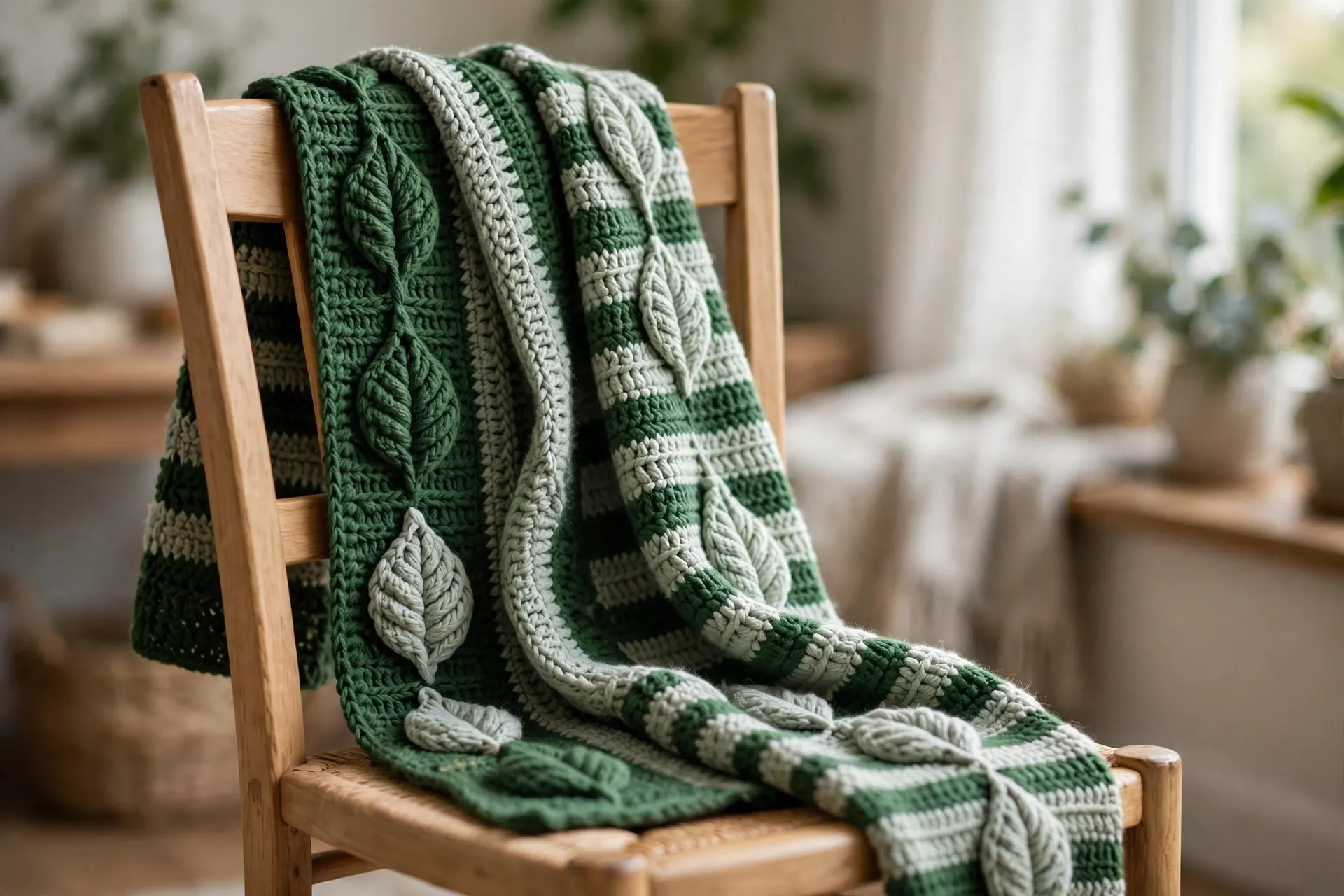
Some stitches decorate the surface of a fabric; this one grows out of it. The leaf stitch crochet pattern builds each leaf in two moves: a plump fan of double crochet forms the wide, rounded base, and on the next row a cluster stitch pulls the fan’s top together into a neat point — a raised, pointed-oval leaf standing proud of a plain background, with no appliqué and no sewing. This tutorial teaches the stitch on a counted practice swatch first, then turns it into a soft two-green scarf with every count written out.
What Is the Leaf Stitch?
The leaf stitch crochet pattern is a textured stitch built from three ordinary ingredients: single crochet for the background, a five-double-crochet fan, and a double-crochet-five-together cluster that gathers the fan into a point. Each leaf takes exactly two rows to grow, so the leaves stack in tidy columns — and by shifting every second leaf row half a repeat sideways, they nestle into the gaps of the row below like leaves on a stem.
The fabric is firm, warm and almost reversible: the leaves stand proudest on the side that faced you when you worked the fan, but they show on both sides. If you enjoy two-row texture stitches, our braid stitch slippers use a staggered puff band for a similar effect, and our poinsettia flower pattern is the leaf’s festive floral cousin.
Materials and Gauge
- Worsted weight (#4) yarn: about 40 yd (37 m) of one colour for the swatch; for the scarf, approx. 700 yd (640 m) in total — about 380 yd of a deep leaf green and 320 yd of a soft sage. A smooth acrylic or wool blend shows the leaves best; avoid fuzzy yarns while you learn, because you need to see the fan stitches clearly. If yarn labels are a puzzle, the Craft Yarn Council’s standard yarn weight system explains what the “#4” means.
- 5.0 mm (US H-8) crochet hook
- Stitch markers (at least 2)
- Tapestry needle, scissors and a tape measure
Gauge: 16 stitches and 12 rows = 4 inches (10 cm) in the leaf stitch pattern, lightly blocked, with worsted yarn and the 5.0 mm hook. Gauge is relaxed for a scarf, but check it before a blanket — leaves that drift in size will not line up.
The stitch multiple: this pattern is a multiple of 8 + 1. Chain a multiple of 8 plus 2 extra chains (18, 26, 34, 42…), which gives you a stitch count of a multiple of 8 + 1: each group of 8 stitches holds one leaf and the plain stitches around it, and the final stitch closes the row.
Useful Materials from Amazon

- Red heart super saver solid yarn
- Made of 100-percent acrylic medium worsted material
- Available for 5-mm knitting needle and 5.5-mm crochet hook
A smooth worsted acrylic in two shades of green makes the leaves read clearly; one ball covers the swatch.

- Easy grip handle
- Amour means love
- Love crochet
Fan rows pack five double crochets into single stitches, so a soft-grip 5 mm hook keeps your hand comfortable.

- [150-Piece Value Set in 10 Colors] Get 150 locking stitch markers in 10 colors (15 per shade) to color-code rows, repeat…
- [Smooth Snag-Free Plastic] Lightweight smooth plastic with a gentle locking clasp slides along yarn without catching or …
- [Works for Knitting & Crochet] The slim profile slips onto standard knitting needles, while the secure locking ring mark…
Clip a marker into the stitch that will hold each fan and counting becomes a glance, not a recount.

- 16 Pcs Knitting Needle Kit: Coming with 12 pieces random colored yarn needle, 3 wool needles, and a box(random color). t…
- The 3 Wool Needles: A set of 3 aluminum wool needles with a flexible clear nylon loop, giving your stitching a flexible …
- Steel Material: This sturdy and durable material can serve you a long period, smooth edges make it easier to stitch, the…
Striped leaves mean plenty of ends; a large-eye tapestry needle hides them neatly along the plain rows.
Abbreviations (US Terms)
- ch = chain
- sc = single crochet
- dc = double crochet
- dc5tog = double crochet 5 together (the gathering cluster — fully explained in Step 3)
- st(s) = stitch(es)
- rep = repeat
- RS = right side
- WS = wrong side
- Fan = 5 dc worked into the same stitch (the base of one leaf)
The Leaf Stitch Crochet Pattern, Step by Step
Follow this leaf stitch crochet pattern on the swatch first: chain 26, which gives three leaves per leaf row and finishes about 6¼ inches wide. Six rows make one complete repeat — a plain row, a leaf row, a gather row, a plain row, an offset leaf row and its gather row. Once the swatch behaves, the scarf in Step 6 is the same six rows on a longer chain.
Step 1 — Materials, Gauge and the Stitch Multiple

Gather your yarn, hook and markers. Every leaf needs 8 stitches of width — 1 stitch for the fan itself and 7 plain single crochets around it — plus 1 closing stitch at the end of the row: the multiple of 8 + 1, which never changes, whatever size you make. Work the swatch below and measure it after two full repeats (12 rows): 16 stitches across and 12 rows down should sit inside 4 inches. Too many stitches means tight work — go up to a 5.5 mm hook; too few, drop to 4.5 mm.
Step 2 — Foundation and Set-Up Row

With your first colour, ch 26.
Row 1 (WS, set-up row): Sc in the 2nd ch from the hook and in every ch across, turn. (25 sc)
That plain row is the soil everything grows from — it also appears inside the repeat as Row 4. Chain loosely: a tight, curling foundation chain will haunt every later row.
Step 3 — The Leaf Row, Stitch by Stitch

Here is the heart of the leaf stitch crochet pattern. A leaf is two rows: the fan row below, the gather row on top.
Row 2 (RS, Leaf Row A): Ch 1, sc in the first st, *work a fan (5 dc) in the next st, sc in the next 7 sts; rep from * twice more, turn. (37 sts — 22 sc and 15 dc: three fans)
The fans sit in stitches 2, 10 and 18 — one single crochet, a five-double-crochet fan (the leaf’s wide, rounded base), then seven plain single crochets, repeated. If your fans sit anywhere else, recount now, while it is cheap.
Row 3 (WS, Gather Row A): Ch 1, sc in the first st, *dc5tog over the next 5 dc, sc in the next 7 sts; rep from * twice more, turn. (25 sts — 22 sc and 3 clusters)
The dc5tog, worked exactly: *(yarn over, insert your hook into the next dc, yarn over and pull up a loop, yarn over and pull through 2 loops)* — do that in each of the fan’s 5 double crochets, so 6 loops sit on your hook, then yarn over and pull through all 6 at once, snugly. The five fan stitches collapse into one: a leaf, pointed at the tip and plump at the base.
Step 4 — The Plain and Offset Rows

Row 4 (RS, plain row): Ch 1, sc in every st across, turn. (25 sc)
One quiet row: it separates the leaf rows, gives the fabric its flat background, and resets your count — if you do not have 25 single crochets here, a fan or cluster went astray above.
Row 5 (WS, Leaf Row B — the offset row): Ch 1, sc in the first 5 sts, *work a fan (5 dc) in the next st, sc in the next 7 sts; rep from * once more, work a fan in the next st, sc in the last 3 sts, turn. (37 sts — 22 sc and 15 dc)
Same fans, same gather to come — but every leaf has shifted 4 stitches sideways, so these leaves sit over the gaps between Row 2’s leaves instead of on top of them. That half-step turns tidy columns into a natural, overlapping leaf pattern.
Row 6 (RS, Gather Row B): Ch 1, sc in the first 5 sts, *dc5tog over the next 5 dc, sc in the next 7 sts; rep from * once more, dc5tog over the next 5 dc, sc in the last 3 sts, turn. (25 sts)
The repeat is complete: Rows 1–6, with Row 1 on later repeats just another plain row like Row 4. Work two full repeats on the swatch and measure your gauge as in Step 1.
Step 5 — Repeating the Pattern and Changing Colours Cleanly

For any project, repeat Rows 1–6 to the length you want, and always finish with a gather row (Row 3 or Row 6) followed by one plain row, so every leaf is closed and both ends match. Count the leaves, not the stitches: three fans on every swatch leaf row, 25 stitches at the end of every plain and gather row.
Change colour only at the end of a plain row (Row 4, or Row 6 before a fresh Row 1), where the join hides in flat fabric, never inside a leaf. Work the last single crochet until 2 loops remain, yarn over with the new colour and pull through, then turn and carry on. Cut the old colour with a 6-inch tail, or carry it loosely up the side — the Step 6 edging covers carried strands.
The scarf below changes colour every two repeats (12 rows): deep leaf green, then soft sage, alternating.
Step 6 — The Scarf Project: Edging and Finishing

Now use the leaf stitch crochet pattern for a finished piece: a scarf four leaves wide, in the two-green stripes of Step 5.
Scarf: With deep leaf green, ch 34. Row 1: sc in the 2nd ch from the hook and in every ch across. (33 sc) Then work Rows 2–6 as for the swatch, with these counts:
- Leaf Rows A: sc in the first st, then *(fan, sc in the next 7 sts)* four times. (49 sts — 29 sc and 20 dc)
- Gather Rows A: sc in the first st, then *(dc5tog, sc in the next 7 sts)* four times. (33 sts)
- Leaf Rows B: sc in the first 5 sts, *(fan, sc in the next 7 sts)* three times, fan, sc in the last 3 sts. (49 sts)
- Gather Rows B: sc in the first 5 sts, *(dc5tog, sc in the next 7 sts)* three times, dc5tog, sc in the last 3 sts. (33 sts)
Work 28 repeats (168 rows) in total, changing colour every two repeats as in Step 5 and ending with a Gather Row B, then Row 169: one plain sc row in deep leaf green (33 sc), so both ends match. The scarf measures about 8¼ × 56 in (21 × 142 cm) before edging.
Edging — Round 1: With deep leaf green, join the yarn in any corner. Ch 1, 33 sc along the top edge, 3 sc in the corner st, 169 sc evenly down the side (1 sc into the end of each row), 3 sc in the corner st, 33 sc along the bottom edge, 3 sc in the corner st, 169 sc evenly up the second side, 3 sc in the corner st, join with a sl st to the first sc. (416 sc)
Edging — Round 2: Ch 1, reverse single crochet (crab stitch) in every st around, join with a sl st to the first reverse sc, fasten off. (416 sts)
Weave in the ends along the backs of the plain rows, then block lightly: pin flat, mist, and let the leaves relax — the corded reverse-crochet frame stops the long edges curling. Prefer your leaves for the home? The same panel, worked wider, makes a striking cushion front like our crochet star cushion.
Tips for Neat, Even Leaves
- Make every fan stitch the same height. Five even double crochets give a plump, symmetrical base; one short stitch in a fan makes a lopsided leaf.
- Pull the cluster closed — then tug once more. The snugger the dc5tog, the sharper the leaf’s pointed tip.
- Keep the background relaxed. The 7 single crochets between leaves set the spacing; too tight, and the fabric puckers around every leaf.
- Block before you judge. Leaves look slightly drunken straight off the hook; a light block sets them upright in their columns.
Common Mistakes and How to Fix Them
- The leaves lean to one side. A fan was worked one stitch out of place, so the gather pulled it crooked. Count the plain stitches between fans (always 7) and unpick to the last straight leaf.
- Flat fans with no point. The gather was worked over the wrong stitches, or not pulled closed. The cluster must swallow exactly the fan’s 5 double crochets and end with a firm pull-through.
- The stitch count keeps changing. Usually a single crochet is skipped after a fan, or an extra one creeps in before the next. Check every plain row: 25 on the swatch, 33 on the scarf, every time.
- Offset leaves stack on top of the first leaves. Leaf Row B was worked like Leaf Row A. Row B starts with 5 single crochets, not 1 — that 4-stitch shift is the whole offset.
Frequently Asked Questions
Is this leaf stitch crochet pattern suitable for beginners?
It suits a confident beginner: you need single crochet, double crochet, and one cluster stitch spelled out loop by loop in Step 3. Master the swatch first — if every plain row ends on 25 stitches, you are ready.
Can I make a blanket with the leaf stitch?
Yes — the fabric is warm, dense and beautiful in panels. Chain a multiple of 8 plus 2 for your width: ch 130 gives 129 stitches, about 32 inches (81 cm) wide at the gauge above. Our roundup of crochet Christmas blanket patterns shows how well textured stitches carry a whole blanket.
Why do my leaves look like round blobs instead of pointed leaves?
Two usual causes: the fan stitches are worked too loosely, so the leaf is all base and no shape, or the cluster is not pulled fully closed. Work the fan firmly, and after the dc5tog’s final yarn-over, tug the working yarn once — the tip sharpens immediately.
How much yarn does the scarf actually use?
About 700 yards of worsted in total — roughly 380 yards of the deep green (which also works the edging) and 320 of sage. Looser tension or extra repeats can push that up, so buy one spare ball.
Final Thoughts
Two rows per leaf, three stitches in your toolbox, and this leaf stitch crochet pattern is yours for life. Make the swatch tonight and the scarf this week; after that, the same gathered fans will quietly suggest cushions, blanket panels and a whole indoor garden of projects. Once you have worked it a few times, the leaf stitch crochet pattern becomes a relaxing, rhythmic favourite.