Cosy Clusters Blanket Crochet Pattern: A Cluster Stitch Blanket in 7 Steps
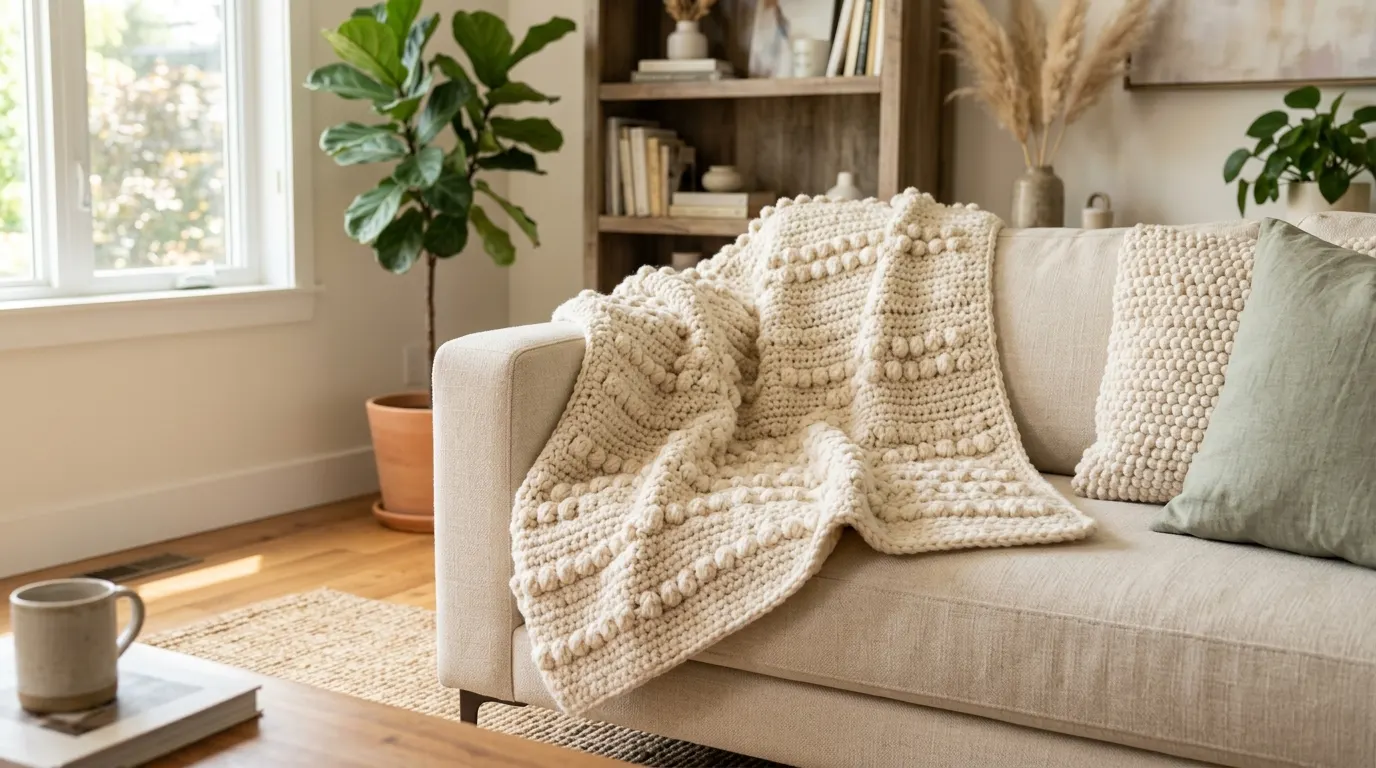
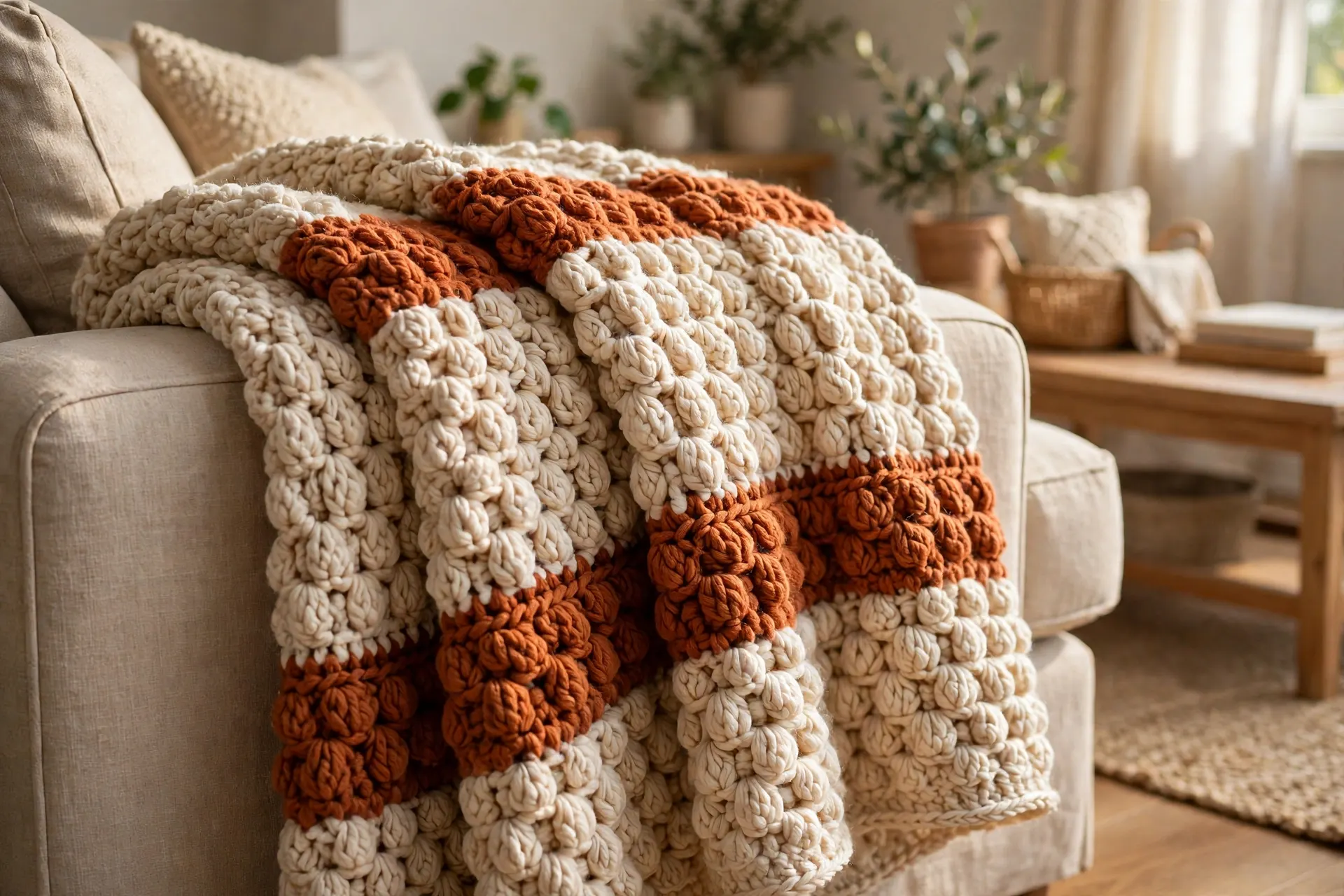
Some blankets are all about complicated stitch charts. This one is about texture you can feel with your eyes closed. This cosy clusters blanket crochet pattern builds a snuggly throw from a single cluster stitch — three double crochets drawn together into one plump little bundle — worked across every second row, with a calm row of single crochet in between. The clusters pop out of the fabric like rows of tiny cushions, the plain rows keep everything flat, and the blanket settles into a two-row rhythm you can work in front of the television.
The finished throw measures about 36 × 48 inches (91 × 122 cm) before the border — a proper lap-and-legs size for a sofa, and a generous cot blanket. Every count is written out in full, so the clusters line up in neat columns.
Why You Will Love This Blanket
- One stitch does everything. Learn the cluster once (Step 3) and there is nothing else new in the blanket — just cluster rows and plain rows, over and over.
- Texture without holes. The clusters sit on a solid single-crochet base, so the throw is warm with no lacy gaps for toes or tiny fingers to poke through.
- It forgives small tension wobbles. The plain row between cluster rows levels the fabric as you go, so edges stay straight without heroic blocking.
- Stripes are effortless. Change colour at the end of a row and the next cluster row blooms in the new shade — no mid-row joins anywhere.
Cluster texture sits beautifully next to other raised stitches: our crochet bobble blanket pattern makes a playful partner piece, and the honeycomb baby blanket uses the same cosy logic in a smaller size.
Materials and Gauge
- Worsted weight (#4) yarn, approx. 1,500 yd (1,370 m) in total — one 220 yd ball covers roughly 18 rows, so plan on about 7 balls. For the striped version shown: approx. 1,150 yd warm cream and 350 yd rust. Smooth acrylic or an acrylic-wool blend is ideal — it shows the clusters crisply and washes well. If yarn labels are new to you, the Craft Yarn Council’s standard yarn weight system explains what the #4 on the band means.
- 5.5 mm (US I-9) crochet hook
- Stitch markers, tapestry (yarn) needle with a large eye, scissors, tape measure, and blocking mats and pins (optional, for Step 7)
Gauge: 14 stitches and 10 rows = 4 inches (10 cm) in the pattern (alternating cluster and plain rows), with worsted yarn and the 5.5 mm hook. At gauge, 127 stitches give a blanket about 36 inches wide and 121 rows give about 48 inches long — roughly 37 × 49 in (94 × 124 cm) once the border is on. Swatch first (Step 1) — if your stitches come out bigger, your blanket will too, which is fine as long as you have the yarn for it.
Useful Materials from Amazon
Everything this cosy clusters blanket crochet pattern needs is standard stash equipment:
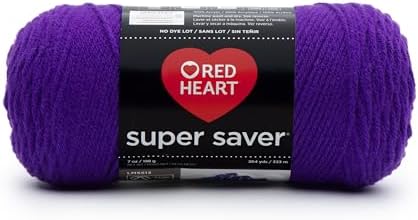
- 100% acrylic
- Red heart super saver print yarn
- Made of 96-percent acrylic and 4 percent other fibers worsted material
A smooth worsted acrylic or blend is the backbone of the blanket — pick one yarn line in both colours so cream and rust work to the same gauge.

- High Quality Material:Our hook head is made of high quality aluminum material, which is durable and not easy to break or…
- Ergonomic Design:Our crochet handles are ergonomically designed. The shape of the grip has been specially designed to al…
- Various Sizes Available:Our crochet hooks are approximately 5.9 inches in length. But we provide you with 9 different si…
Nearly four thousand clusters is a lot of yarn-overs; a soft-grip 5.5 mm hook keeps your hand comfortable to the last row.

- 【Vibrant Colors, Easy to Spot】Each set includes over 7 randomly assorted vibrant colors, making these crochet stitch mar…
- 【Perfect Fit for Most Yarns】Measuring 0.87 inches, these flexible stitch markers for crocheting and knitting are the per…
- 【100 Markers with Handy Storage】Includes 100 high-quality crochet markers and knitting stitch markers, plus a clear 3.3 …
A marker in every 25th stitch turns counting a 127-stitch row into four quick checks — cheap insurance against a wandering edge.
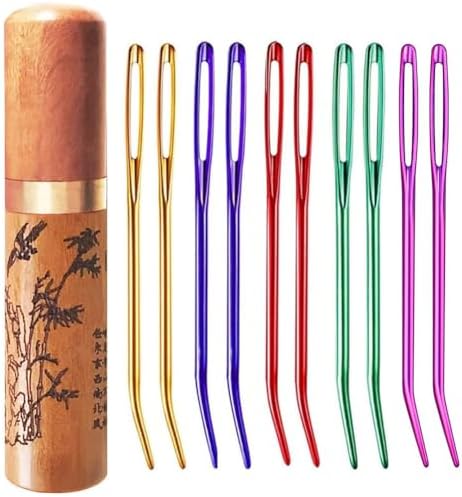
- PACKAGE INCLUDING: 10 x aluminum Large Eye Yarn Needles, 1 x Wooden Needle Case Carving Pattern. 5 different colors and …
- LARGE EYE OPENING FOR EASY THREADING: Every yarn needle, tapestry needle and darning needle in this set is designed with…
- EXQUISITE CARVED WOODEN STORAGE TUBE FOR NEAT ORGANIZATION: Equipped with a premium carved wooden storage case to store …
A blunt, large-eye needle weaves yarn tails invisibly into the backs of the clusters, and a small set means one is always in the project bag.
Abbreviations (US Terms)
- ch = chain
- sc = single crochet
- dc = double crochet
- st(s) = stitch(es)
- sp = space
- rep = repeat
- Cluster (CL) = (yarn over, insert hook in the stitch, yarn over and pull up a loop, yarn over and pull through 2 loops) 3 times in the SAME stitch (4 loops on hook), yarn over and pull through all 4 loops. Fully explained in Step 3.
The Cosy Clusters Blanket Crochet Pattern, Step by Step
Work the throw in one piece: a plain foundation row, then the two-row repeat (cluster row, plain row) to full length, then the border. Counts are given for every row — if yours match, the cluster columns stack perfectly.
Step 1 — Materials and Gauge

Gather everything above and swatch before you commit to 1,500 yards of blanket: chain 22, work Row 1 (21 sc), then work the cluster and plain rows from Steps 3 and 4 until you have about 4 inches of fabric. Measure the middle, un-stretched: 14 stitches across and 10 pattern rows down should sit inside 4 inches (10 cm). Too many stitches? Go up to a 6.0 mm hook. Too few? Drop to 5.0 mm. Ten minutes of swatching is the difference between a 36-inch throw and a 44-inch surprise.
Step 2 — Foundation Chain and First Row

With cream, chain 128, keeping the chain relaxed — a tight chain is the main reason first blankets bow in the middle.
- Row 1: Sc in the 2nd chain from the hook and in every chain across. (127 sc)
This plain row is the foundation the clusters stand on. Count once now: 127 is an odd number, and odd is essential, because the cluster row needs a stitch left over to end on (Step 3).
Step 3 — The Cluster Row, Stitch by Stitch

Here is the only new technique in this cosy clusters blanket crochet pattern, so take the first cluster slowly.
The cluster, defined exactly: yarn over, insert your hook into the stitch, yarn over and pull up a loop, yarn over and pull through 2 loops — one half-finished double crochet, with 2 loops left on the hook. Working into the SAME stitch, repeat that half-finished double crochet twice more: 3 little legs joined at the base, 4 loops on the hook. Yarn over once more and pull through all 4 loops. The legs pinch together at the top into one plump cluster.
- Row 2 (cluster row): Ch 1 (does not count as a stitch), work a CL in the first stitch, *ch 1, skip the next stitch, CL in the next stitch; rep from * across. (64 clusters and 63 ch-1 spaces)
Check the arithmetic before you turn: you worked into stitches 1, 3, 5 … all the way to stitch 127 — the odd-numbered stitches — which is 64 clusters, and skipped the 63 even-numbered stitches, leaving a ch-1 space over each skip. Pull each cluster’s final yarn-over snugly: a plump, tight crown is what makes the texture pop rather than flop.
Step 4 — The Return Row and the Two-Row Repeat

- Row 3 (plain row): Ch 1, sc in the first cluster, *sc in the next ch-1 space, sc in the next cluster; rep from * across. (127 sc)
This quiet row does three jobs: it locks the tops of the clusters so they puff forwards, it gives you a firm stitch to work the next cluster row into, and it restores the full count of 127. Row 4 is exactly Row 2 again: a cluster in the first stitch — directly above the first cluster of the row below — a ch-1 over the space stitch, and so on. Because every cluster lands above a cluster, the columns stack straight up the blanket; glance down them every few rows to check.
The repeat is Rows 2 and 3 — cluster row, plain row, all the way to Step 5’s row count.
Step 5 — Working to Full Length

Repeat Rows 2–3 until you have 121 rows in total: the foundation Row 1 plus 60 full repeats. That is 60 cluster rows — 3,840 clusters — and at gauge the blanket measures about 48 inches long. End with a plain row (Row 121), so the top edge matches the bottom ready for the border.
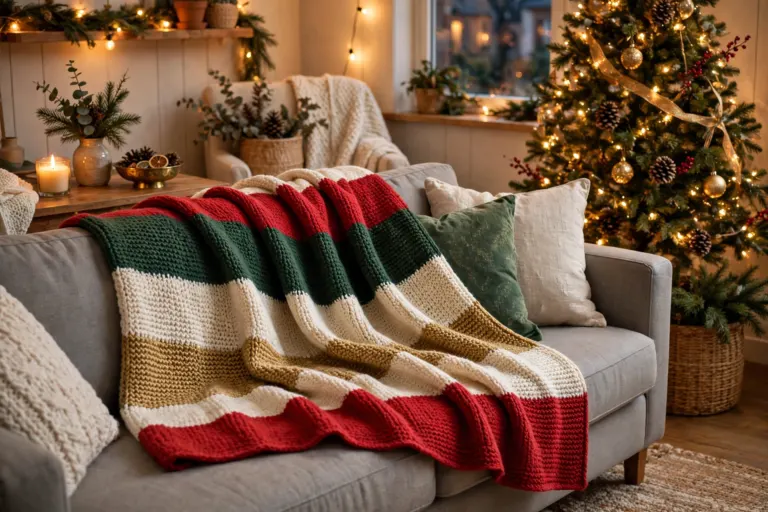
Optional stripes (as photographed): work Rows 1–30 in cream, Rows 31–40 in rust, Rows 41–81 in cream, Rows 82–91 in rust, and Rows 92–121 in cream — two rust bands sitting symmetrically either side of the centre. Change colour at the end of the row before a band starts: work the last stitch of the old colour up to its final yarn-over, pull through with the new colour, and turn. Each band is 10 rows tall (5 cluster rows, 5 plain rows). Cut the old colour leaving a 6-inch tail — carry nothing up the sides — and weave tails in during Step 7.
Check the width every 20 rows or so: a lost stitch caught at row 40 is a five-minute fix — at row 120 it is not.
Step 6 — Border Rounds

Three simple rounds frame the blanket. Work with the right side facing throughout.
- Border Round 1: Join cream with a sl st in any corner stitch. Ch 1, sc in every stitch across the top (127 sc), 3 sc in the corner stitch, sc in the end of every row down the side (121 sc), 3 sc in the corner stitch, sc in every stitch across the bottom (127 sc), 3 sc in the corner stitch, sc in the end of every row up the last side (121 sc), 3 sc in the final corner stitch. Join with a sl st to the first sc. (508 sc)
- Border Round 2: Ch 2 (counts as an hdc), hdc in every stitch around, working 3 hdc into the centre sc of each 3-sc corner. Join with a sl st to the top of the ch-2. (516 hdc)
- Border Round 3: Ch 1, work reverse single crochet (crab stitch) in every stitch around, join with a sl st to the first stitch and fasten off. (516 sts)
The corded edge stops the border stretching out of shape in use and washing. For a softer nursery finish, replace Round 3 with a second hdc round in rust.
Step 7 — Finishing, Blocking and Care

Fasten off and weave in every tail with the tapestry needle, running each one through the backs of the clusters in two directions so nothing works loose in the wash — the striped version has ten tails, and this is the moment they disappear for good.
Block lightly to finish: lay the blanket flat on mats, pat it out to about 37 × 49 inches (border included), squaring the corners and straightening the cluster columns, pin the corners and a few points along each edge, and leave it for a few hours. Cluster fabric barely needs blocking — this is polishing, not rescue work.
Care: machine wash cool and gentle, reshape while damp and dry flat. The clusters stand a little prouder once the yarn has relaxed.
Tips for Plump, Even Clusters
- Pull up to the same height every time. Draw each of the cluster’s three legs up a little taller than a normal dc — that extra height is the puff.
- Snug the crown. The final yarn-over through all 4 loops sets the cluster’s shape; pull it firmly so the top pinches closed and the cluster bulges forward.
- Count clusters, not stitches. At the end of a cluster row, just count 64 clusters — far faster than counting 127 stitches, and it catches a missed skip immediately.
- Let the plain row do its work. Work Row 3 at your normal tension, not tighter: it is the scaffold that keeps this blanket flat, the same way the plain rounds steady our waffle stitch pillow.
Common Mistakes and How to Fix Them
- Clusters lean or twist instead of standing plump. One of the three legs went into the neighbouring stitch. All three legs share one base stitch — check each cluster has a single “foot”.
- The stitch count changed mid-row. A skip was forgotten (you gain a cluster and lose a space) or two stitches were skipped (you lose a cluster). Count 64 clusters at the end of every cluster row; on plain rows the count must come home to 127.
- The edges slope outward. The first or last stitch of a row is being missed — usually the small sc at the edge of a plain row. Mark both edge stitches and work into each marker as you reach it.
- The fabric looks flat, like bumpy single crochet. Your legs are not pulled up high enough, or the crowns are loose. Taller legs plus a firm final yarn-over is the whole fix — this cosy clusters blanket crochet pattern gets its look from that one habit.
Frequently Asked Questions
Is this cosy clusters blanket crochet pattern suitable for beginners?
Yes — for a beginner comfortable with single and double crochet. The cluster is just three half-finished double crochets joined at the top, and Step 3 walks through it loop by loop. Master ten clusters on the swatch and you have every skill the blanket needs.
How do I make the blanket bigger or smaller?
Keep two rules: the stitch count stays odd, and the length grows in whole repeats. For a baby blanket of about 28 × 36 inches, chain 100 (99 sc), work 91 rows (Row 1 plus 45 repeats), and expect 50 clusters per cluster row — more sizes live in our roundup of crochet baby blanket patterns. For a 48-inch-wide throw, chain 170 (169 sc) and keep 121 rows. Adjust the border the same way: one sc per stitch along top and bottom, one sc per row end along the sides.
How much yarn does one throw actually take?
About 1,500 yards of worsted for the size written — roughly 1,150 yards cream and 350 yards rust striped. Cluster stitch uses about a third more yarn than plain double crochet, so buy the extra ball in the same dye lot now rather than hunting for it later.
Can I work the blanket in one colour?
Absolutely — in a single warm cream the clusters read as pure texture and the blanket looks gently quilted. Stripes simply make the rows easier to count.
Final Thoughts
Learn one cluster and you have this whole blanket: two rows, repeated sixty times, while the texture builds itself. This cosy clusters blanket crochet pattern makes the kind of throw that lives permanently on the sofa arm — warm without being heavy, textured without being fussy, sturdy enough for everyday naps, dens and dog cuddles. Work the first one in cream and rust; a festive version from our crochet Christmas blanket patterns tends to join the queue next.