Wrapped in Love: 7 Crochet Baby Blanket Patterns That Are Actually Worth Making
A baby blanket is the project most likely to be kept for decades, so it deserves a pattern that behaves: soft, washable, the right size, and interesting enough that you still enjoy row 100. These crochet baby blanket patterns were chosen with exactly that in mind. The first one — a gentle moss stitch blanket — is written out in full below, every row counted, and the other six follow with honest notes on stitch, yarn and who each one suits.
Why These Crochet Baby Blanket Patterns Are Worth Making
- They finish. Every blanket here uses a repeat you can memorise, so the project moves instead of stalling in a drawer.
- They wash. Babies are messy; all seven are planned in yarns that survive the machine.
- They feel as good as they look. No stiff, scratchy or holey fabrics a parent would quietly stop using.
The Complete Pattern: Soft Moss Stitch Baby Blanket
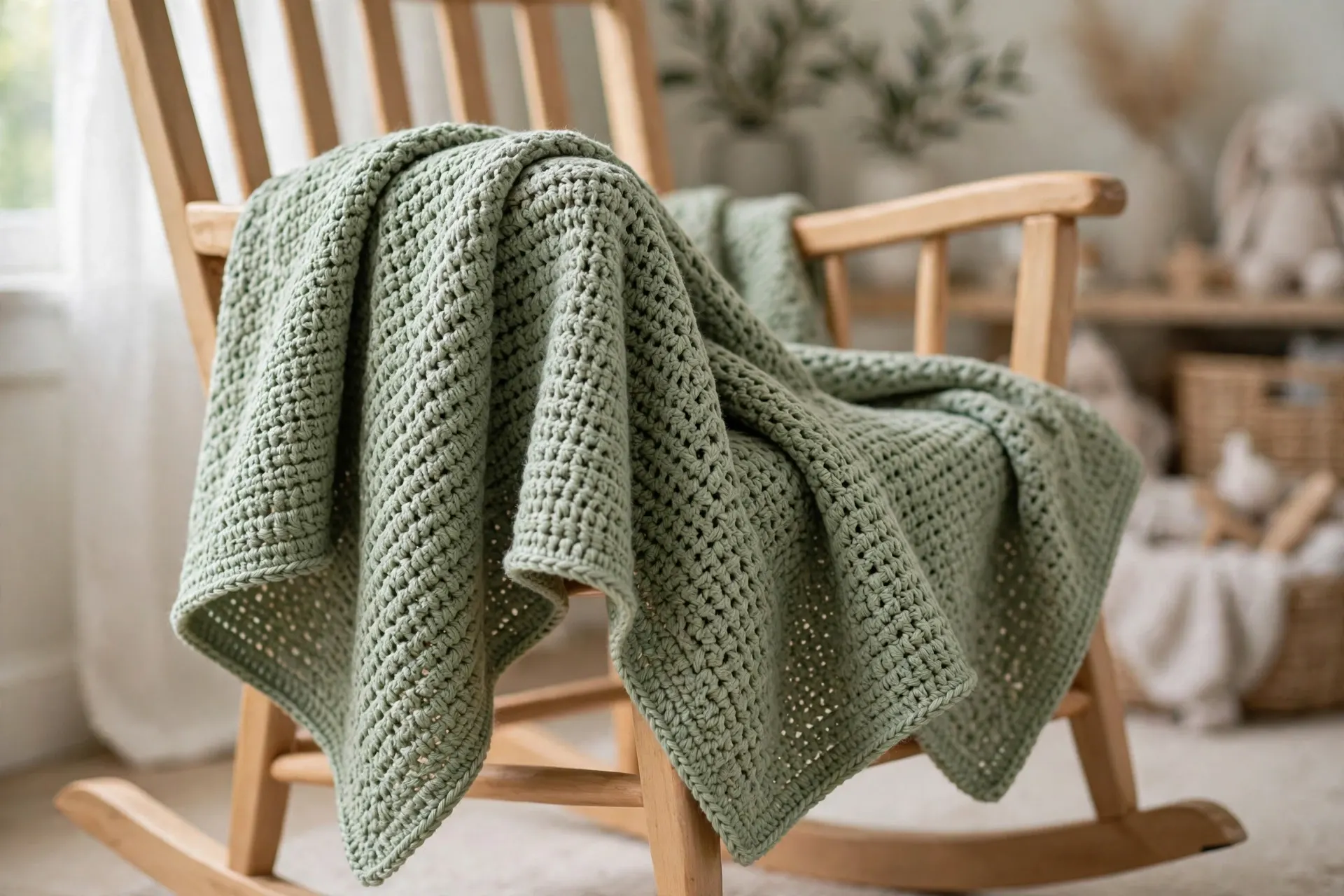
Of all the crochet baby blanket patterns I have made for gifts, this moss stitch blanket is the one parents ask for again. Moss stitch (also called linen stitch) alternates single crochet and chains, giving a woven, pebble-like texture with no holes for tiny fingers to catch in — and the fabric stays soft and floppy instead of board-stiff. It is worked in one colour, in one piece; the main size fits a crib or pram at about 32 × 36 in (81 × 91 cm).
Materials
- Worsted weight (#4) soft acrylic yarn: approx. 1,050 yd (960 m) for the main size — about three standard 350 yd balls. Choose a smooth, tightly spun acrylic (see the safety section for why)
- 5.0 mm (US H-8) crochet hook
- Yarn needle with a large eye
- Scissors
- Measuring tape
- Stitch marker (optional)
Gauge and Sizes
Gauge: 16 sts and 16 rows = 4 in (10 cm) in moss stitch, counting each single crochet and each chain-1 space as a stitch.
Swatch first: chain 22 and work the moss stitch rows from Steps 2 and 3 until the piece is about 4.5 in (11 cm) tall. The middle 4 in (10 cm) should measure 16 stitches across and 16 rows — too many stitches, go up a hook size; too few, go down.
Not sure what the #4 on the label means? The Craft Yarn Council’s standard yarn weight system explains the yarn weight numbers.
The main size is written in full below. The blanket scales by chain and row count only — the stitch never changes:
| Size | Chain | Sts per row | Rows | Finished size (approx.) | Yarn (approx.) |
|---|---|---|---|---|---|
| Lovey | 74 | 37 sc + 36 spaces | 72 | 18 × 18 in (46 × 46 cm) | 300 yd (275 m) |
| Stroller | 114 | 57 sc + 56 spaces | 128 | 28 × 32 in (71 × 81 cm) | 800 yd (730 m) |
| Baby blanket (main) | 130 | 65 sc + 64 spaces | 144 | 32 × 36 in (81 × 91 cm) | 1,050 yd (960 m) |
| Crib | 146 | 73 sc + 72 spaces | 200 | 36 × 50 in (91 × 127 cm) | 1,600 yd (1,460 m) |
Abbreviations (US Terms)
- ch = chain
- sc = single crochet
- sp = space (the chain-1 space from the row below)
- st(s) = stitch(es)
- rep = repeat
- sl st = slip stitch
Step 1 — Gather Your Materials and Check Your Gauge

Lay out your yarn, hook and tools, then work the gauge swatch and adjust your hook until 16 stitches and 16 rows measure 4 in (10 cm). On a blanket this size, being one stitch out per 4 in changes the finished width by two inches, so five minutes of swatching now saves a blanket that misses the crib.
Step 2 — Foundation Chain and First Row

- Ch 130.
- Row 1: Sc in the 2nd ch from the hook, *ch 1, skip the next ch, sc in the next ch; rep from * across. (65 sc and 64 ch-1 spaces)
Count before you go on: 65 single crochet, ending in the very last chain. If it does not, the chain count drifted — far easier to restart this one row than to live with a slanted blanket.
Step 3 — Work the Moss Stitch Rows

- Row 2: Ch 1, turn. Sc in the first sc, *ch 1, sc in the next ch-1 space; rep from * across. (65 sc and 64 ch-1 spaces)
Repeat Row 2 for every row from here: every single crochet lands in a chain space and every chain floats over a single crochet, so the stitches stack into a woven checkerboard. Count the sc at the end of every few rows — it must always be 65. A dropped count usually means a missed space at a row end, where the last chain space hides against the turning chain — find it before it compounds.
Step 4 — Finish the Body and Check Your Size

Work until you have 144 rows in total, ending with a Row 2 repeat. Fasten off, leaving a tail of about 6 in (15 cm). Lay the blanket flat and measure: it should be close to 32 in (81 cm) wide and 36 in (91 cm) long. A quarter inch either way is normal; if you are a full inch short on length, work two more rows before the border — moss stitch grows slightly in the wash, but not by an inch.
Step 5 — Add the Border

The border firms the edges, hides the row-end chains and stops the sides waving.
- Round 1: Join the yarn in any corner stitch. Ch 1, then work sc evenly around: 129 sc across the top edge (one in each sc and each ch-1 space), 3 sc in the corner, 144 sc down the side (one in the end of each row), 3 sc in the corner, 129 sc across the bottom edge (into the base of the foundation row’s stitches and spaces), 3 sc in the corner, and 144 sc up the last side, 3 sc in the final corner. Join with a sl st to the first sc. (558 sc)
- Round 2: Ch 1, sc in each st around, working 3 sc into the middle stitch of each corner group of 3. Join with a sl st to the first sc. (566 sc) Fasten off.
Step 6 — Weave In Ends and Block Lightly

Weave in both tails with the yarn needle, running each back and forth through the backs of stitches in at least two directions. On a baby blanket this is a safety step, not just tidiness: a loose end is a loop a small finger can find. Moss stitch needs only light blocking: lay it flat, pat the edges straight, mist with water and dry. Do not pin hard or stretch it — the fabric should stay soft and drapey.
Step 7 — Final Wash and the Gift-Ready Check

Wash the blanket before gifting, on a gentle cycle in cool water, and dry it flat or on the lowest tumble setting. Then do the check every baby blanket deserves: run your hands over the whole surface feeling for loose ends, knots or rough joins, tug each border corner once, and hold it up to the light to check for thin patches. If it passes, fold it once, and it is ready.
6 More Crochet Baby Blanket Patterns to Try
The moss stitch blanket above is the all-rounder. Here is what matters about the other six crochet baby blanket patterns before you commit your yarn.
2. Gold Puffs Baby Blanket
- Stitch: Puff stitches in neat rows or offset, giving a raised, cloud-like surface.
- Best yarn: Soft worsted acrylic — puffs eat yarn, so budget roughly a third more than a flat blanket of the same size.
- Size: Typically about 32 × 36 in (81 × 91 cm).
- Difficulty: Easy to intermediate — one new stitch, then a simple repeat.
- Time: 14 to 18 hours.
- Tip: Keep every puff’s loops the same height or the surface turns lumpy; if you love the stitch, my cotton candy crochet pattern works the same puffs into a striped blanket with full counts.
3. Windowpane Gingham Baby Blanket
- Stitch: Plain double crochet in three shades of one colour, with the unused colours carried inside the stitches to form gingham checks.
- Best yarn: Smooth DK or worsted cotton or acrylic in white plus two strengths of the same colour.
- Size: About 34 × 36 in (86 × 91 cm).
- Difficulty: Intermediate — the crochet is plain; the colour carrying needs steady counting.
- Time: 16 to 20 hours.
- Tip: Carry the yarns loosely. Tight carried strands pucker the checks and shrink the blanket by inches.
4. Daisy Garden Blanket
- Stitch: Small daisy motifs — a yellow centre with white petal rounds — squared off into granny-style squares and joined.
- Best yarn: DK acrylic or cotton in yellow, white and a soft green or pastel for the squaring rounds.
- Size: Grows square by square; 36 squares makes about 30 × 36 in (76 × 91 cm).
- Difficulty: Easy to intermediate — each square is simple; the joining is the project.
- Time: 15 to 20 hours, much of it in portable short sittings.
- Tip: Join as you go on each square’s final round — a pile of 36 unjoined squares is where daisy blankets go to wait forever.
5. Berry Blossom Baby Blanket
- Stitch: Bobble stitches clustered like berries against a smooth background of half double crochet.
- Best yarn: Soft worsted acrylic in one main colour with a contrast for the bobbles.
- Size: About 32 × 34 in (81 × 86 cm).
- Difficulty: Intermediate — bobbles must land in counted positions.
- Time: 14 to 18 hours.
- Tip: Bobbles are always worked from the wrong side so they pop to the front; for a whole blanket built on this stitch, see my crochet bobble blanket pattern with its full round-by-round counts.
6. Colorful Half Stripe Baby Blanket
- Stitch: Half double crochet stripes where each colour block covers half the row.
- Best yarn: Any soft worsted — this is the best stash-buster on the page, made for leftover half balls.
- Size: About 30 × 34 in (76 × 86 cm), easily adjusted.
- Difficulty: Beginner.
- Time: 10 to 14 hours.
- Tip: Weave the colour-change ends in as you go, a few at a time. Twenty tails at the end is the part everyone regrets. For hot climates, the same stripes in cotton become one of these breathable crochet summer blanket patterns.
7. Friendship Baby Blanket
- Stitch: A cosy, hygge-style mix — usually bands of textured stitches or a gentle chevron in muted, friendly colours.
- Best yarn: Worsted acrylic or an acrylic-wool blend for warmth; keep colours in one muted family.
- Size: About 32 × 36 in (81 × 91 cm).
- Difficulty: Beginner to intermediate, depending on how many stitch bands you include.
- Time: 14 to 18 hours.
- Tip: Swatch each stitch band first — textured bands pull in at different rates, and one narrow band hourglasses the whole piece. If you enjoy textured stitches at blanket scale, the honeycomb crochet baby blanket free pattern is a lovely next make.
Choosing Yarn for Baby Blankets: Safety First
Across all crochet baby blanket patterns, yarn choice matters more for babies than for any other project, because the blanket will be chewed, dragged and washed constantly.
Choose smooth, tightly spun yarn. Loose, fuzzy or hairy yarns — mohair blends, brushed acrylics, eyelash yarns — shed fibres a baby can inhale or swallow, and long loops can wrap tiny fingers. A smooth worsted acrylic or cotton is the safe default.
Choose machine-washable, always. If the label says hand wash, the blanket will quietly stop being used. Acrylic and superwash-treated yarns survive weekly washing, which is exactly what a baby blanket gets.
Skip the extras. No buttons, beads, sewn-on plastic eyes or ribbon loops on a blanket for a baby under three — anything that can work loose is a hazard; a plain woven texture like the moss stitch above needs no decoration.
Wash before first use. Yarn carries mill finishes and shop dust. One gentle wash, as in Step 7 of the hero pattern, makes any of these crochet baby blanket patterns ready for a newborn.
Common Baby Blanket Mistakes (and How to Avoid Them)
- Making it the wrong size. A 24 in square is outgrown in weeks. Aim for 30–36 in wide so the blanket works from pram to toddler naps.
- Choosing a holey stitch for a newborn. Open lace traps tiny fingers and toes. Save lacy patterns for older babies and photo props; use dense stitches like moss, half double crochet or bobbles for everyday blankets.
- Working too loosely. A soft drape is lovely, a net is not. If you can push a fingertip through the fabric easily, go down a hook size.
- Forgetting the blanket will be washed weekly. Delicate fibres and pale silk blends lose. Test-wash your gauge swatch — if it felts or fades, change yarn before you start.
- Leaving long tails and knots. Every end must be woven in two directions (Step 6). A worked-loose tail is the most common way baby blankets unravel.
Frequently Asked Questions
What size should a crochet baby blanket be?
For everyday use, 30 to 36 in (76 to 91 cm) wide and a similar length — the hero pattern’s main size, 32 × 36 in (81 × 91 cm). Its table also gives lovey, stroller and crib sizes.
What is the best yarn for crochet baby blanket patterns?
A smooth, tightly spun, machine-washable worsted acrylic or cotton. It stays soft, sheds no loose fibres, and survives the weekly washing a baby blanket actually gets. Avoid fuzzy, hairy or hand-wash-only yarns.
How long does a baby blanket take to crochet?
The moss stitch hero blanket takes about 12 to 16 hours — two to three weeks of evenings. Motif blankets like the daisy garden take longer overall but break into portable pieces.
Are textured blankets safe for newborns?
Yes, if the texture is woven into the fabric — moss stitch, bobbles and puffs are fine because nothing can come loose. What is not safe is anything attached: buttons, beads, ribbons or long loops. For unsupervised sleep, follow safe-sleep guidance: a plain, light blanket with no extras.
Can I sell baby blankets made from these patterns?
Yes — selling your finished blankets at markets and fairs is fine. Please do not copy and redistribute the written patterns themselves.
Final Thoughts
The best crochet baby blanket patterns are not the most complicated ones — they are the ones still in daily use when the baby turns three. Start with the moss stitch blanket for a guaranteed finish, pick a motif or gingham for a keepsake project, and always choose yarn for the washing machine the blanket will actually meet. Leftover yarn afterwards? The tiny outfits in my crochet doll clothes patterns roundup use the same soft yarns at doll scale.